
KPV Peptide: A Plain-English Research Guide
On this page
What is KPV?
KPV is a tiny peptide of just three amino acids: lysine, proline and valine (Lys-Pro-Val). It is the last three amino acids of alpha-melanocyte-stimulating hormone (α-MSH), a natural hormone best known for skin pigmentation but also known to calm inflammation.1
Researchers found that this short tail of α-MSH keeps much of the hormone's anti-inflammatory activity without its pigment effects. That makes KPV a focused research tool for studying inflammation, especially in the gut.15
KPV is a three-amino-acid fragment of α-MSH that researchers study for its anti-inflammatory effects, especially in laboratory models of inflammatory bowel disease. Full Scale Peptides supplies it as a freeze-dried powder with a published COA, for research use only.
KPV at a glance
Amino acids
Lys-Pro-Val, the C-terminal end of the 13-amino-acid hormone α-MSH.
Parent hormone
KPV keeps the anti-inflammatory activity of α-MSH without its pigmentation role.
Gut transporter
Intestinal cells take KPV in through the PepT1 peptide transporter.
Our current lot
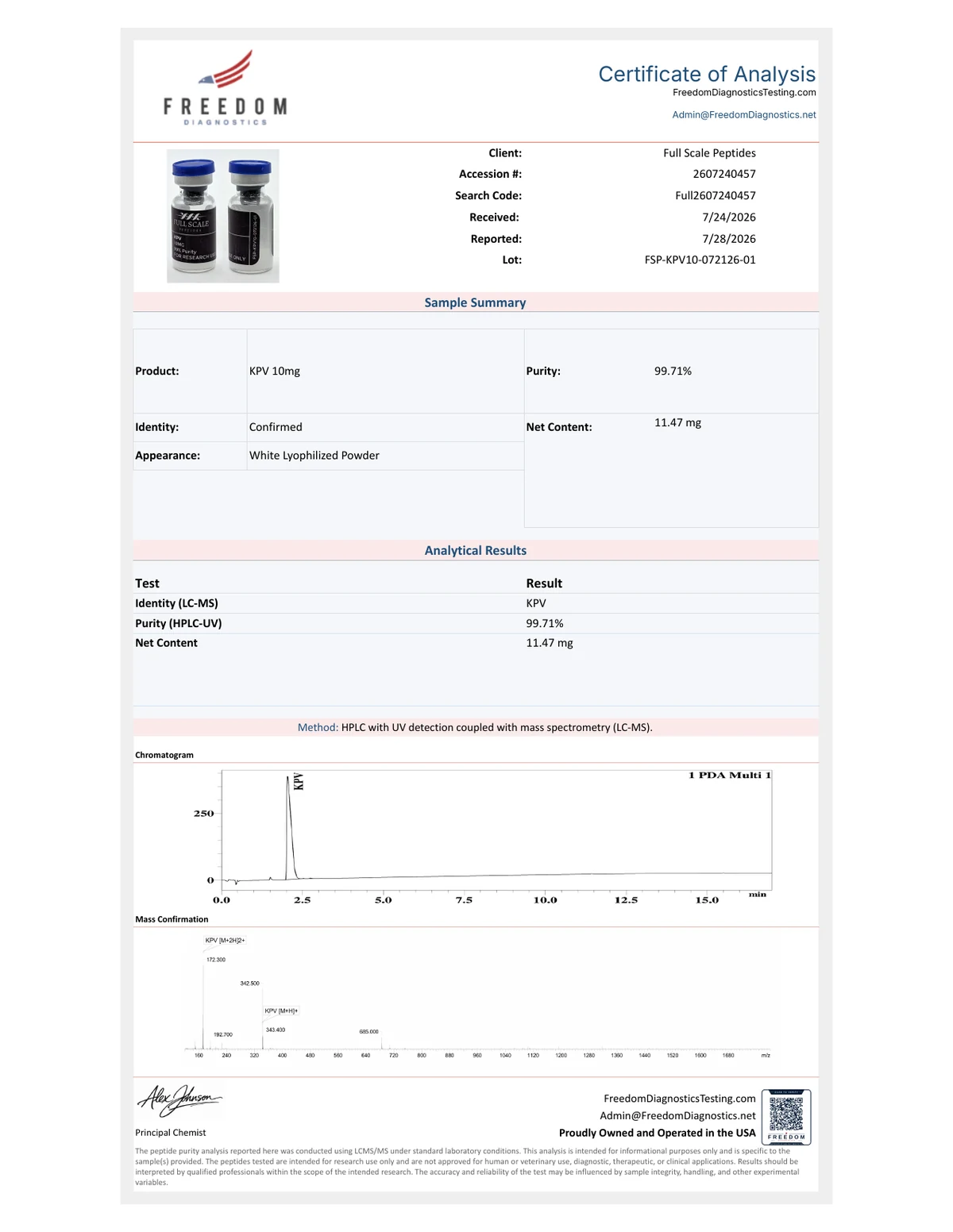
HPLC purity for lot FSP-KPV10-072126-01, with identity confirmed by LC-MS.
How KPV works
Inflammation inside cells is largely switched on by a master control protein called NF-κB, which turns on genes for inflammatory signals (cytokines). In laboratory studies, KPV reduced NF-κB activation and the production of these inflammatory cytokines.2
A key discovery was how KPV gets into gut cells. Intestinal lining cells carry a transporter called PepT1, which normally absorbs small peptides from digested food. Researchers showed that PepT1 carries KPV into these cells, where it can act directly on inflammatory signaling. PepT1 is especially active in inflamed gut tissue.2
Interestingly, KPV's anti-inflammatory effect doesn't seem to depend entirely on the melanocortin receptors that α-MSH normally uses. In mouse colitis models, KPV still reduced inflammation in mice lacking a working MC1R receptor.3
This page summarizes published cell and animal research. It does not describe any use of KPV in people or animals. KPV from Full Scale Peptides is sold strictly for laboratory research.
What scientists study KPV for
- Inflammatory bowel disease models. In mouse models of colitis, KPV reduced signs of inflammation and tissue damage.23
- Targeted delivery. Researchers have packaged KPV in nanoparticles designed to release in the colon, which improved results in colitis models compared with plain KPV.4
- Inflammatory signaling. Cell studies on NF-κB, cytokine production and immune-cell responses.1
- Skin and other tissues. Because α-MSH is active in skin, KPV also appears in research on skin inflammation.5
Almost all KPV research is in cells and mice, and there are essentially no controlled human data. Its small size also means it is broken down and cleared quickly, which is why so much of the recent work focuses on delivery methods such as nanoparticles.
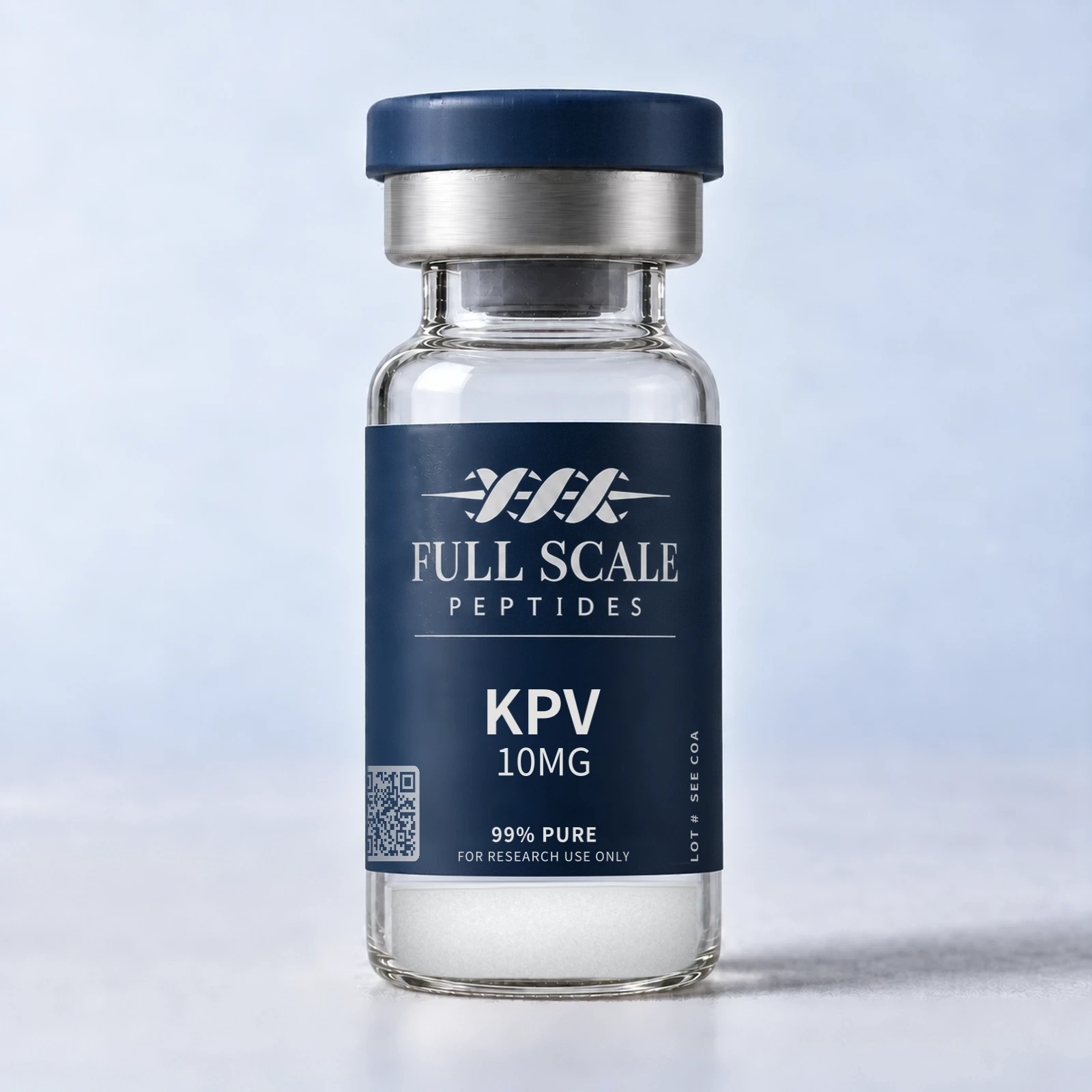
KPV 10mg, research grade
Freeze-dried powder with a third-party COA published before you buy, and tracked U.S. shipping. For laboratory research use only.
Purity and testing: why the COA matters
With only three amino acids, KPV leaves little room for error: a single wrong or missing amino acid changes the molecule completely. Every KPV lot from Full Scale Peptides is tested by an independent lab, Freedom Diagnostics, before it is sold. HPLC measures purity, LC-MS confirms the exact sequence, and the full report is published before you buy.
- Lot
- FSP-KPV10-072126-01
- Tested
- Jul 28, 2026
- Lab
- Freedom Diagnostics
- Measured content
- 11.47 mg (10 mg labeled)
- Accession #
- 2607240457
- Report
- View full COA
New to reading lab reports? See how to read and verify a Certificate of Analysis and why 99%+ purity matters in research.
How KPV is handled in the lab
KPV ships as a lyophilized (freeze-dried) powder, meaning the water has been removed to keep the peptide stable. Store sealed vials at −20 °C, protected from light. Before use in research it is reconstituted, or dissolved back into a liquid, usually with bacteriostatic water. Handling it the same careful way every time keeps results consistent:
- Let the sealed vial come to room temperature before opening it, to limit condensation.
- Add the water slowly down the inside wall of the vial, not directly onto the powder.
- Swirl gently until the powder is fully dissolved. Don’t shake it.
- Label the vial with the date, keep it refrigerated at 2–8 °C away from light, and avoid repeated freeze–thaw cycles.
For more detail, see our reconstitution guide and storage and handling best practices.
Key takeaways
- KPV is a three-amino-acid peptide (Lys-Pro-Val), the tail end of the hormone α-MSH.
- It keeps α-MSH's anti-inflammatory activity and reduces NF-κB signaling in lab studies.
- Gut cells take it in through the PepT1 transporter, which is especially active in inflamed tissue.
- It reduced inflammation in mouse colitis models, but human data are essentially absent.
- Our current lot tests at 99.71% purity, with identity confirmed by LC-MS and the full COA published. For laboratory research use only.
Frequently asked questions
What does KPV stand for?
It stands for its three amino acids in single-letter code: lysine (K), proline (P) and valine (V).
How is KPV related to α-MSH?
KPV is the last three amino acids of α-MSH. It keeps much of the hormone's anti-inflammatory activity but not its role in pigmentation.
What is KPV studied for?
Mainly inflammation, especially in mouse models of inflammatory bowel disease, plus research on targeted delivery and inflammatory signaling.
What purity is Full Scale Peptides' KPV?
The current lot (FSP-KPV10-072126-01) measured 99.71% purity by HPLC, with identity confirmed by LC-MS at Freedom Diagnostics. The full Certificate of Analysis is published in our COA library.
How is KPV supplied and stored?
It ships as a 10 mg lyophilized powder in a sealed glass vial. Store unopened vials at −20 °C away from light. Once reconstituted, keep the vial refrigerated at 2–8 °C.
Is KPV for human or veterinary use?
No. It is sold strictly for laboratory research. It is not for human or veterinary use and must not be administered to people or animals.
Scientific references
The findings summarized on this page come from published scientific literature, available on PubMed. Full Scale Peptides did not conduct, fund or sponsor this research, and nothing here implies endorsement by the authors or their institutions. The studies describe research on KPV itself, not the product we supply.
- Brzoska T, Luger TA, Maaser C, et al. Alpha-melanocyte-stimulating hormone and related tripeptides: biochemistry, antiinflammatory and protective effects in vitro and in vivo, and future perspectives for the treatment of immune-mediated inflammatory diseases. Endocr Rev. 2008;29(5):581–602. PMID: 18612139
- Dalmasso G, Charrier-Hisamuddin L, Nguyen HT, et al. PepT1-mediated tripeptide KPV uptake reduces intestinal inflammation. Gastroenterology. 2008;134(1):166–178. PMID: 18061177
- Kannengiesser K, Maaser C, Heidemann J, et al. Melanocortin-derived tripeptide KPV has anti-inflammatory potential in murine models of inflammatory bowel disease. Inflamm Bowel Dis. 2008;14(3):324–331. PMID: 18092346
- Xiao B, Xu Z, Viennois E, et al. Orally targeted delivery of tripeptide KPV via hyaluronic acid-functionalized nanoparticles efficiently alleviates ulcerative colitis. Mol Ther. 2017;25(7):1628–1640. PMID: 28143741
- Brzoska T, Böhm M, Lügering A, et al. Terminal signal: anti-inflammatory effects of α-melanocyte-stimulating hormone related peptides beyond the pharmacophore. Adv Exp Med Biol. 2010;681:107–116. PMID: 21222263
Continue your research
For laboratory research use only. Not for human or veterinary use. The information on this page is provided for educational purposes and describes published research; it is not medical advice, and no statement here has been evaluated by the FDA.