
DSIP (Delta Sleep-Inducing Peptide): A Plain-English Research Guide
On this page
What is DSIP?
DSIP stands for Delta Sleep-Inducing Peptide. A peptide is a short chain of amino acids, the same building blocks that make up proteins. DSIP is a small one: just nine amino acids long (Trp-Ala-Gly-Gly-Asp-Ala-Ser-Gly-Glu). Its name comes from “delta sleep,” the deep, slow-wave stage of sleep that shows up as large, slow waves on an EEG.
DSIP was first isolated in 1977 by a research group in Basel, Switzerland, from the blood of rabbits kept in a state of deep sleep.1 DSIP-like material has since been detected in the hypothalamus, the limbic system and several peripheral tissues, which hints that it may have more than one job.2
What makes DSIP unusual is what’s still missing. Most signaling peptides act on a known receptor, the specific “docking site” on a cell. No receptor for DSIP has ever been confirmed. Researchers have reported interactions with several neurotransmitter systems, including serotonergic, dopaminergic and glutamatergic pathways, and early animal work described it crossing the blood–brain barrier.3 Exactly how it acts is still open, which is why one review called it “a still unresolved riddle.”5
DSIP is a nine-amino-acid peptide, first isolated from sleeping rabbits in 1977, that scientists study in laboratory research on sleep, stress signaling and nerve-cell recovery. Full Scale Peptides supplies it as a freeze-dried powder with a published COA, for research use only.
DSIP at a glance
Amino acids
One of the smallest signaling peptides that researchers have named and characterized.
First isolated
By the Schoenenberger–Monnier group in Basel, from rabbits in induced deep sleep.
Confirmed receptors
Nearly 50 years on, no dedicated receptor has been identified, so its mechanism remains an open question.
Our current lot
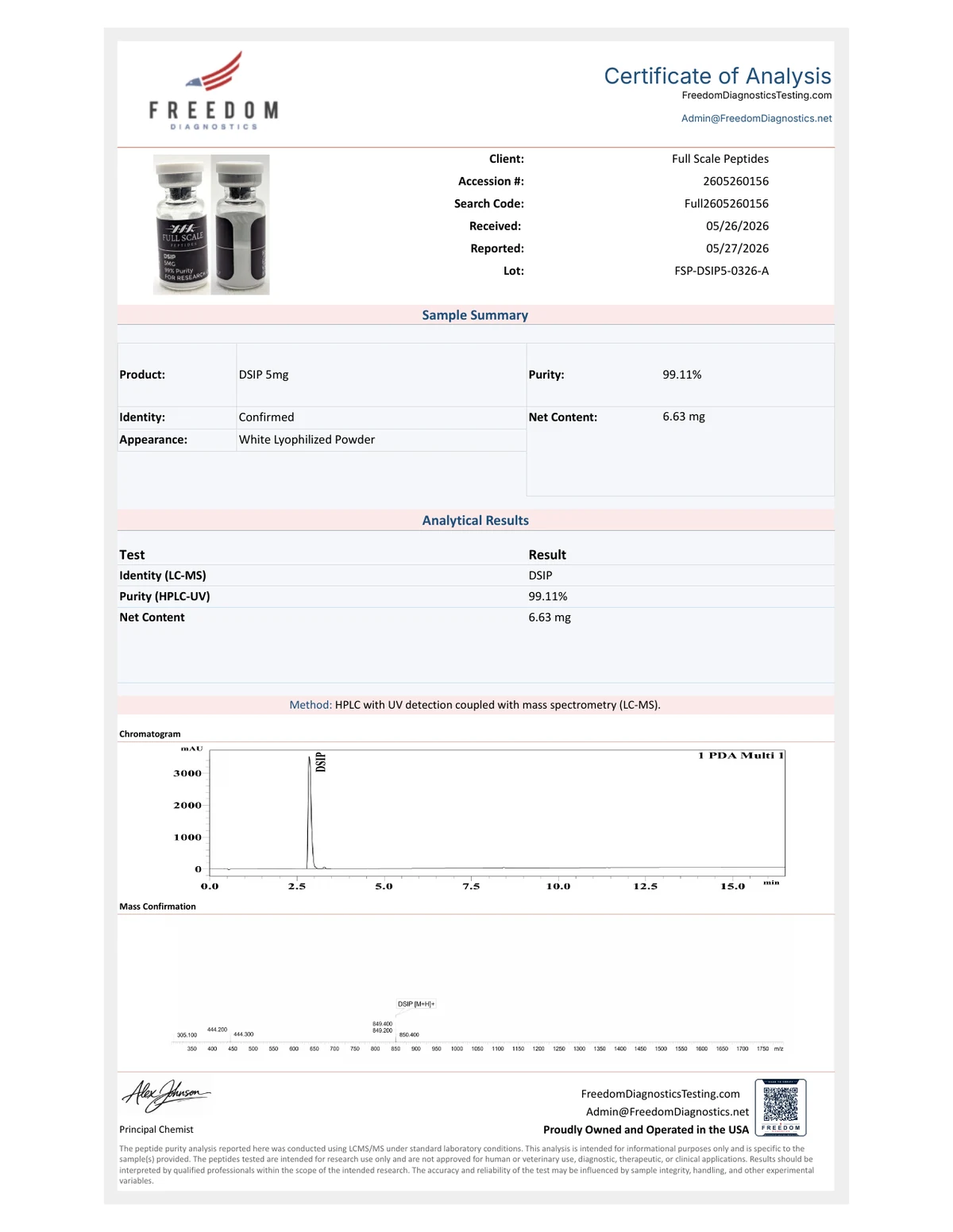
HPLC purity for lot FSP-DSIP5-0326-A, with identity confirmed by LC-MS. Report published below.
How DSIP was discovered
For more than a century, scientists have wondered whether the body makes its own “sleep signals,” substances that build up and help tip the brain into sleep. In the 1970s, Guido Schoenenberger and Marcel Monnier took this idea into the lab. They collected blood from rabbits held in deep, slow-wave sleep, transferred extracts to other animals, and watched for changes in their brain-wave recordings.
In 1977 they reported the final isolation and structure of the active substance: a nine-amino-acid peptide they named for the delta waves it seemed to enhance.1 A synthetic version followed, and the same group reported that the synthetic peptide could pass from the bloodstream into the brain in rabbits.3
Since then, the picture has become more complicated, not simpler:
- The sleep link is inconsistent. Some early studies reported more slow-wave sleep without suppression of REM sleep; others found little or no effect.2,5
- No receptor has been found. Without a confirmed receptor, it’s hard to say exactly how DSIP produces the effects reported for it.
- It appears throughout the body. DSIP-like immunoreactivity has been measured in the brain, in the pituitary gland and in peripheral organs.4
- The reported effects are wide-ranging. They include brain electrical activity, stress hormones, body temperature and daily rhythms, but no single agreed-upon role has emerged.
This page summarizes what has been published about DSIP, much of it older or preliminary animal research. It does not promise any result and does not describe use in people or animals. DSIP from Full Scale Peptides is sold strictly for laboratory research.
What scientists study DSIP for
Because its role is unsettled, DSIP appears across a surprisingly broad range of research. The most common areas in the literature are:
- Sleep architecture. EEG studies in animal models measure whether DSIP shifts slow-wave (delta) sleep, and whether it changes the overall pattern of sleep stages rather than simply causing sedation.2
- Stress signaling. Studies have examined how DSIP interacts with the hypothalamic-pituitary-adrenal (HPA) axis, including reports of lower ACTH and corticosterone responses under stress conditions in lab models.2
- Circadian rhythm. Researchers have looked at possible links between DSIP and daily timing of activity, temperature and hormone release.
- Mitochondria and low oxygen. Rat studies have explored DSIP’s effects on mitochondrial respiration in brain tissue and on resistance to experimental hypoxia.6
- Nerve-cell recovery. More recent work tested whether DSIP affects motor-function recovery in rats after an induced focal stroke.7
DSIP is one of the most studied yet least understood peptides. Results are mixed, and much of the foundational work dates from the 1970s and 1980s. Scientists treat it as an open research question, not a settled story.
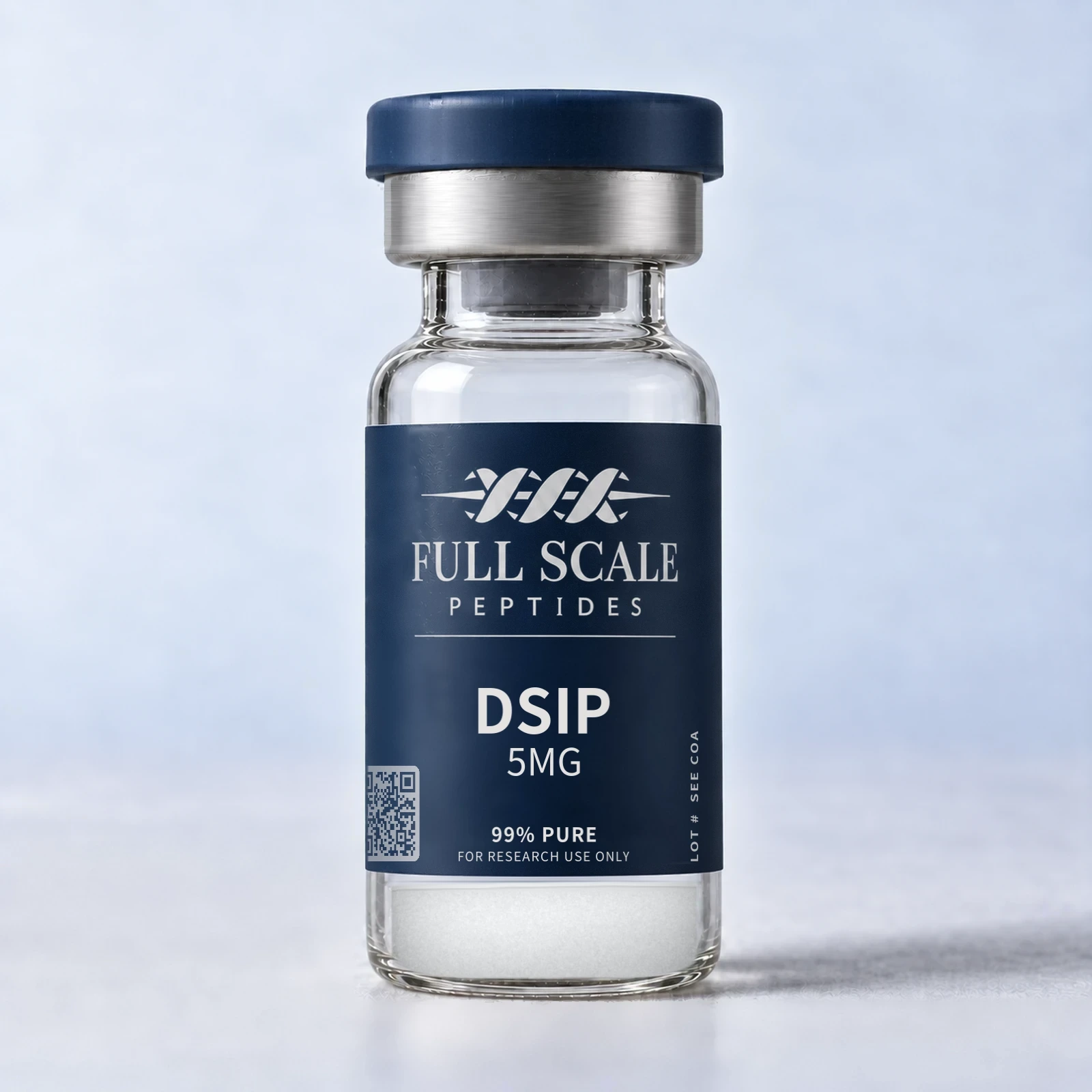
DSIP 5mg, research grade
Freeze-dried powder with a third-party COA published before you buy, and tracked U.S. shipping. For laboratory research use only.
Purity and testing: why the COA matters
Research results are only as reliable as the material they start with, and that matters even more for a compound whose effects are still debated. Every DSIP lot from Full Scale Peptides is tested by an independent lab, Freedom Diagnostics, before it is sold. HPLC measures purity, LC-MS confirms the molecule is actually DSIP, and the full report is published on the site before you buy.
(5 mg labeled)
- Lot
- FSP-DSIP5-0326-A
- Tested
- May 27, 2026
- Lab
- Freedom Diagnostics
- Accession #
- 2605260156
- Report
- View full COA
New to reading lab reports? See how to read and verify a Certificate of Analysis and why 99%+ purity matters in research.
How DSIP is handled in the lab
DSIP ships as a lyophilized (freeze-dried) powder, meaning the water has been removed to keep the peptide stable. Store sealed vials at −20 °C, protected from light. Before use in research it is reconstituted, or dissolved back into a liquid, usually with bacteriostatic water. Handling it the same careful way every time keeps results consistent:
- Let the sealed vial come to room temperature before opening it, to limit condensation.
- Add the water slowly down the inside wall of the vial, not directly onto the powder.
- Swirl gently until the powder is fully dissolved. Don’t shake it.
- Label the vial with the date, keep it refrigerated at 2–8 °C away from light, and avoid repeated freeze–thaw cycles.
For more detail, see our reconstitution guide and storage and handling best practices.
Key takeaways
- DSIP is a nine-amino-acid peptide first isolated in 1977 from the blood of rabbits in deep sleep.
- It’s named for delta (slow-wave) sleep, but the sleep link has been inconsistent across studies.
- No receptor has ever been confirmed, so its mechanism is still an open research question.
- It is studied in research on sleep, stress signaling, circadian rhythm, mitochondrial function and nerve-cell recovery, mostly in animal models.
- Our current lot tests at 99.11% purity, with identity confirmed by LC-MS and the full COA published. For laboratory research use only.
Frequently asked questions
What does DSIP stand for?
Delta Sleep-Inducing Peptide. “Delta sleep” is the deep, slow-wave stage of sleep, named for the large, slow delta waves it produces on an EEG.
Does DSIP reliably increase deep sleep?
The evidence is mixed. Some early animal studies reported more slow-wave sleep, while others found little effect. Reviews describe the sleep connection as unresolved, which is a big reason DSIP is still studied.
Why is DSIP called a “riddle”?
It was discovered almost 50 years ago and has been linked to many effects, yet no dedicated receptor has been identified and its exact role in the body is still unclear.
What purity is Full Scale Peptides’ DSIP?
The current lot (FSP-DSIP5-0326-A) measured 99.11% purity by HPLC, with identity confirmed by LC-MS at Freedom Diagnostics. The full Certificate of Analysis is published on the product page and in our COA library.
How is DSIP supplied and stored?
It ships as a 5 mg lyophilized powder in a sealed glass vial. Store unopened vials at −20 °C away from light. Once reconstituted, keep the vial refrigerated at 2–8 °C.
Is DSIP for human or veterinary use?
No. It is sold strictly for laboratory research. It is not for human or veterinary use and must not be administered to people or animals.
Scientific references
The findings summarized on this page come from published scientific literature, available on PubMed. Full Scale Peptides did not conduct, fund or sponsor this research, and nothing here implies endorsement by the authors or their institutions. The studies describe research on DSIP itself, not the product we supply.
- Schoenenberger GA, Maier PF, et al. A naturally occurring delta-EEG enhancing nonapeptide in rabbits. X. Final isolation, characterization and activity test. Pflügers Arch. 1977;369(2):99–109. PMID: 560681
- Graf MV, Kastin AJ. Delta-sleep-inducing peptide (DSIP): a review. Neurosci Biobehav Rev. 1984;8(1):83–93. PMID: 6145137
- Monnier M, Dudler L, Gächter R, et al. Transport of the synthetic peptide DSIP through the blood-brain barrier in rabbit. Experientia. 1977;33(12):1609–1610. PMID: 590449
- Graf MV, Kastin AJ. Delta-sleep-inducing peptide (DSIP): an update. Peptides. 1986;7(6):1165–1187. PMID: 3550726
- Kovalzon VM, Strekalova TV. Delta sleep-inducing peptide (DSIP): a still unresolved riddle. J Neurochem. 2006;97(2):303–309. PMID: 16539679
- Khvatova EM, Samartzev VN, Zagoskin PP, et al. Delta sleep inducing peptide (DSIP): effect on respiration activity in rat brain mitochondria and stress protective potency under experimental hypoxia. Peptides. 2003;24(2):307–311. PMID: 12668217
- Tukhovskaya EA, Ismailova AM, Shaykhutdinova ER, et al. Delta sleep-inducing peptide recovers motor function in SD rats after focal stroke. Molecules. 2021;26(17):5173. PMID: 34500605
Continue your research
For laboratory research use only. Not for human or veterinary use. The information on this page is provided for educational purposes and describes published research; it is not medical advice, and no statement here has been evaluated by the FDA.