
BPC-157: A Plain-English Research Guide
On this page
What is BPC-157?
BPC-157 stands for Body Protection Compound-157. It is a synthetic peptide made of 15 amino acids (a “pentadecapeptide”), based on part of a protective protein that researchers found in human gastric juice.1 Its sequence is Gly-Glu-Pro-Pro-Pro-Gly-Lys-Pro-Ala-Asp-Asp-Ala-Gly-Leu-Val, with a molecular weight of about 1,419 Da.
BPC-157 has been studied for more than 30 years, much of it by a research group in Zagreb, Croatia, led by Predrag Sikirić.2 That work has looked at the peptide in laboratory models of tissue repair, blood-vessel growth, gut lining protection and tendon and muscle healing, which makes it one of the most discussed peptides in preclinical research.
BPC-157 is a 15-amino-acid peptide derived from a stomach protein that scientists study in laboratory and animal models of tissue repair, blood-vessel growth and gut protection. Full Scale Peptides supplies it as a freeze-dried powder for research use only.
BPC-157 at a glance
Amino acids
A pentadecapeptide based on a partial sequence of a protein found in gastric juice.
First described
Early papers introduced BPC as a new gastric juice peptide with protective effects.
In gastric juice
Unusually resistant to breakdown in stomach acid, which is rare for a peptide.
Controlled human trials
The evidence is almost entirely from cell and animal studies.
Why BPC-157 is unusual
Two things set BPC-157 apart in the research literature:
- Stability. Most peptides are broken down quickly in the stomach. In laboratory testing, BPC-157 has shown unusual resistance to breakdown in gastric juice, which made it easy to study in gut research models.1
- The range of models studied. Published work covers stomach and intestinal injury, tendon and ligament injury, muscle crush injury, blood-vessel injury and nerve regeneration. Few peptides have been tested across so many different tissues.2
How researchers think it works
Preclinical studies have proposed several connected mechanisms. Three appear most often:
1. Blood-vessel growth (the VEGF pathway)
Injured tissue needs a restored blood supply to heal. In cell studies, BPC-157 increased the migration and tube-forming behavior of blood-vessel cells, and the findings pointed to activation of the VEGFR2 receptor and its signaling chain.3 Related work reviews its effects across different blood-vessel injury models.4
2. The nitric oxide system
The Zagreb group has repeatedly reported that BPC-157's effects change when the nitric oxide (NO) system is blocked or boosted in experiments.14 NO controls blood-vessel tone, platelet behavior and gut-lining defense, so researchers see this as one possible explanation for effects seen across very different organs.
3. Cell migration and growth-factor signaling
In tendon research, BPC-157 was associated with more outgrowth from tendon samples, better cell survival under oxidative stress and faster cell migration, with signaling work pointing to the FAK–paxillin pathway.5 Later work reported increased growth-hormone receptor expression in tendon cells.6 Other studies have linked it to EGR-1, a gene that switches on growth factors involved in wound repair.7
Everything on this page describes published cell and animal research. It does not promise any result and does not describe use in people or animals. BPC-157 from Full Scale Peptides is sold strictly for laboratory research.
What scientists study BPC-157 for
- Gut models. This is the deepest part of the literature, including stomach lesion, fistula and inflammatory bowel models.1
- Tendon, ligament and muscle models. A 2019 review found consistently positive results in rodent tendon, ligament and muscle-injury models. It also stressed the near-total lack of human data.8
- Blood-vessel models. Studies of vessel injury and of alternate blood routes forming after a blockage.4
- Nerve models. A smaller body of work on peripheral nerve regeneration.
Three limits matter when reading this literature. It is almost entirely cell and animal work. A large share comes from a small group of collaborating labs, so independent replication is thin. And a result in one injury model does not automatically apply to another. None of that makes BPC-157 less interesting, but it makes verified starting material more important.
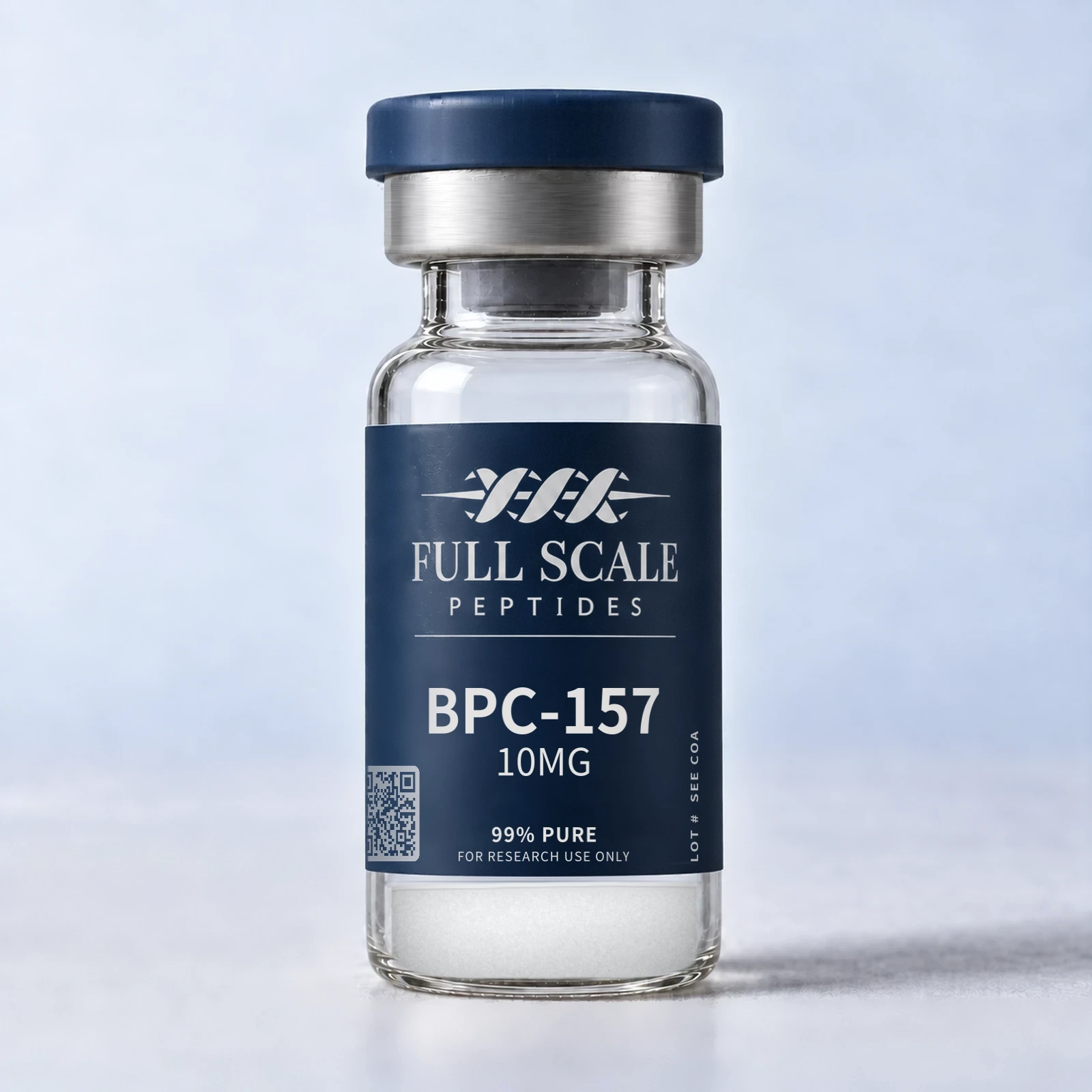
BPC-157 10mg, research grade
Freeze-dried powder with a third-party COA published before you buy, and tracked U.S. shipping. For laboratory research use only.
Purity and testing: why the COA matters
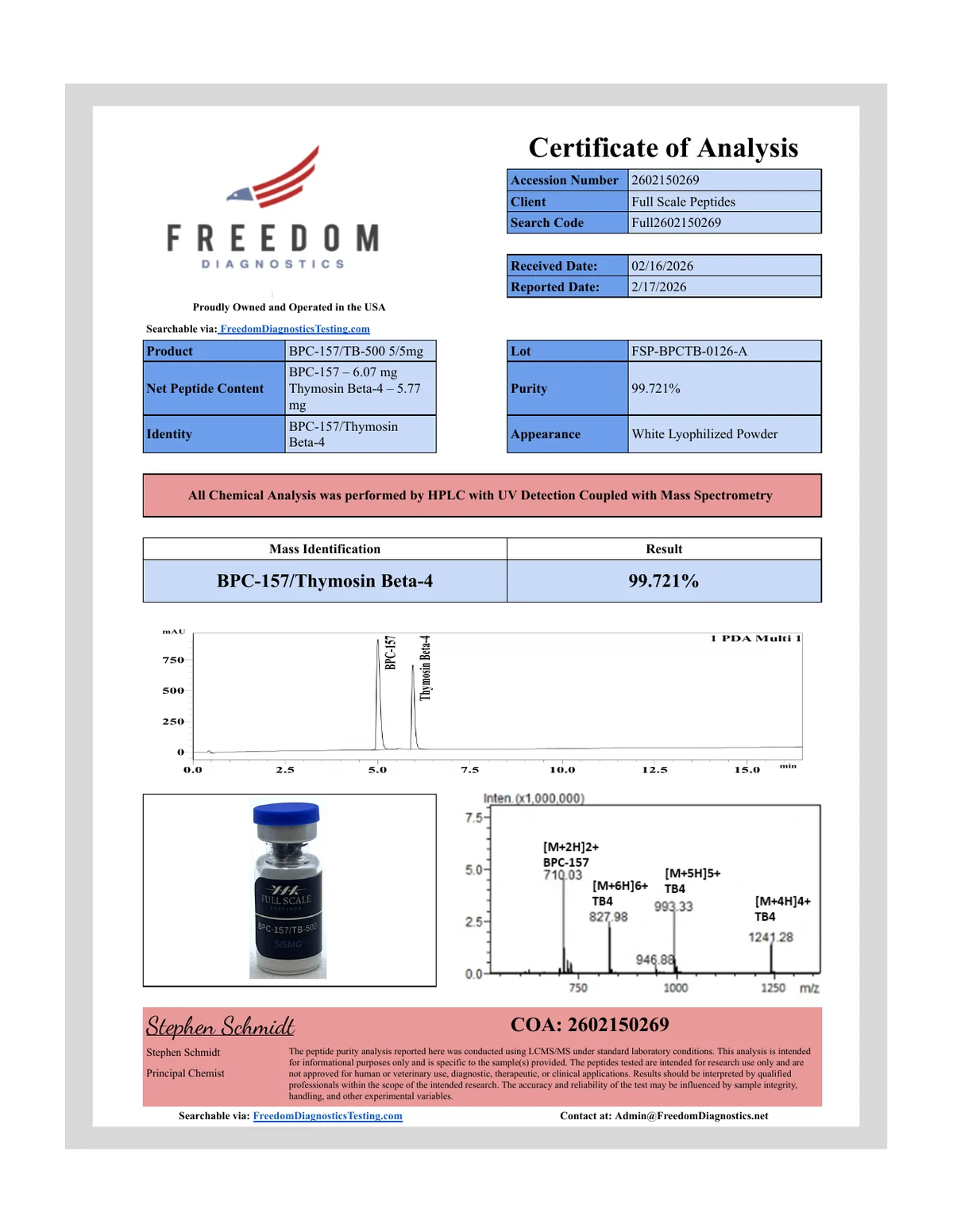
With a literature this concentrated, reproducible results depend on knowing exactly what is in the vial. Every BPC-157 lot from Full Scale Peptides is sent to an independent lab, Freedom Diagnostics, where HPLC measures purity and LC-MS confirms identity, and reports are published in our COA library.
The most recent published report containing BPC-157 is for our Wolverine Blend (BPC-157 / TB-500), which confirmed the BPC-157 sequence by LC-MS:
(5 mg labeled)
- Product
- Wolverine Blend (BPC-157 / TB-500)
- Lot
- FSP-BPCTB-0126-A
- Tested
- Feb 17, 2026
- Lab
- Freedom Diagnostics
- Accession #
- 2602150269
- Report
- View full COA
New to reading lab reports? See how to read and verify a Certificate of Analysis and why 99%+ purity matters in research.
How BPC-157 is handled in the lab
BPC-157 ships as a lyophilized (freeze-dried) powder, meaning the water has been removed to keep the peptide stable. Store sealed vials at −20 °C, protected from light and moisture. Before use in research it is reconstituted, or dissolved back into a liquid, usually with bacteriostatic water. Handling it the same careful way every time keeps results consistent:
- Let the sealed vial come to room temperature before opening it, to limit condensation.
- Add the water slowly down the inside wall of the vial, not directly onto the powder.
- Swirl gently until the powder is fully dissolved. Don’t shake it.
- Label the vial with the date, keep it refrigerated at 2–8 °C away from light, and avoid repeated freeze–thaw cycles.
For more detail, see our reconstitution guide and storage and handling best practices.
BPC-157 is often studied alongside TB-500 in repair research. That pairing is available as our Wolverine Blend (BPC-157 / TB-500), and with GHK-Cu added as the GLOW Blend.
Key takeaways
- BPC-157 is a 15-amino-acid peptide based on part of a protective protein found in gastric juice.
- It is unusually stable in stomach acid and has been studied across gut, tendon, muscle, blood-vessel and nerve models.
- The leading proposed mechanisms are VEGF-driven blood-vessel growth, the nitric oxide system and growth-factor-driven cell migration.
- The evidence is almost entirely preclinical and concentrated in a few labs, with essentially no controlled human data.
- Every lot is independently tested by HPLC and LC-MS, with reports published in our COA library. For laboratory research use only.
Frequently asked questions
What does BPC-157 stand for?
Body Protection Compound-157. The name reflects its origin in research on a protective protein found in gastric juice.
What is BPC-157 studied for?
Mainly tissue repair in laboratory and animal models, including gut lining injury, tendon and ligament injury, muscle injury and blood-vessel injury.
Has BPC-157 been tested in humans?
Controlled human trial data are essentially absent. Almost all published evidence comes from cell and animal studies.
What is the difference between BPC-157 and TB-500?
They are different peptides studied for overlapping repair effects. BPC-157 is linked mainly to blood-vessel growth and the nitric oxide system, while TB-500 is a fragment of thymosin beta-4 studied for cell migration. See our BPC-157 vs TB-500 comparison.
How is BPC-157 supplied and stored?
It ships as a 10 mg lyophilized powder in a sealed glass vial. Store unopened vials at −20 °C away from light and moisture. Once reconstituted, keep the vial refrigerated at 2–8 °C.
Is BPC-157 for human or veterinary use?
No. It is sold strictly for laboratory research. It is not for human or veterinary use and must not be administered to people or animals.
Scientific references
The findings summarized on this page come from published scientific literature, available on PubMed. Full Scale Peptides did not conduct, fund or sponsor this research, and nothing here implies endorsement by the authors or their institutions. The studies describe research on BPC-157 itself, not the product we supply.
- Sikiric P, Seiwerth S, Rucman R, et al. Stable gastric pentadecapeptide BPC 157: novel therapy in gastrointestinal tract. Curr Pharm Des. 2011;17(16):1612–1632. PMID: 21548867
- Sikirić P, Petek M, Rucman R, et al. A new gastric juice peptide, BPC. An overview of the stomach-stress-organoprotection hypothesis and beneficial effects of BPC. J Physiol Paris. 1993;87(5):313–327. PMID: 8298609
- Hsieh MJ, Liu HT, Wang CN, et al. Therapeutic potential of pro-angiogenic BPC157 is associated with VEGFR2 activation and up-regulation. J Mol Med (Berl). 2017;95(3):323–333. PMID: 27847966
- Seiwerth S, Brcic L, Vuletic LB, et al. BPC 157 and blood vessels. Curr Pharm Des. 2014;20(7):1121–1125. PMID: 23782145
- Chang CH, Tsai WC, Lin MS, et al. The promoting effect of pentadecapeptide BPC 157 on tendon healing involves tendon outgrowth, cell survival, and cell migration. J Appl Physiol. 2011;110(3):774–780. PMID: 21030672
- Chang CH, Tsai WC, Hsu YH, et al. Pentadecapeptide BPC 157 enhances the growth hormone receptor expression in tendon fibroblasts. Molecules. 2014;19(11):19066–19077. PMID: 25415472
- Tkalcević VI, Cuzić S, Brajsa K, et al. Enhancement by PL 14736 of granulation and collagen organization in healing wounds and the potential role of egr-1 expression. Eur J Pharmacol. 2007;570(1–3):212–221. PMID: 17628536
- Gwyer D, Wragg NM, Wilson SL. Gastric pentadecapeptide body protection compound BPC 157 and its role in accelerating musculoskeletal soft tissue healing. Cell Tissue Res. 2019;377(2):153–159. PMID: 30915550
Continue your research
For laboratory research use only. Not for human or veterinary use. The information on this page is provided for educational purposes and describes published research; it is not medical advice, and no statement here has been evaluated by the FDA.