
Kisspeptin-10: A Plain-English Research Guide
On this page
What is Kisspeptin-10?
Kisspeptin-10 is a ten-amino-acid peptide (Tyr-Asn-Trp-Asn-Ser-Phe-Gly-Leu-Arg-Phe-NH₂) and the shortest fully active member of the kisspeptin family. Kisspeptins are made from the KISS1 gene. The longer forms (kisspeptin-54, -14 and -13) all share the same ten amino acids at their tail end, and that short sequence is enough to fully activate the receptor.1
That receptor is KISS1R, originally called GPR54. In 2001, two groups independently showed that kisspeptins are its natural ligands.12 The name has an unusual origin: the KISS1 gene was first identified in cancer research as a metastasis suppressor, which is why the longest form is also called metastin.2
Kisspeptin-10 is a ten-amino-acid peptide that activates the KISS1 receptor, the “master switch” upstream of GnRH, and it is used in laboratory research on puberty, fertility and reproductive hormone signaling. Full Scale Peptides supplies it as a freeze-dried powder with a published COA, for research use only.
Kisspeptin-10 at a glance
Amino acids
The C-terminal fragment shared by every kisspeptin form, and all that is needed for full receptor activation.
Receptor match
Kisspeptins were identified as the natural ligands of the orphan receptor GPR54, now KISS1R.
Puberty link
Loss of working KISS1R was shown to block normal puberty, putting kisspeptin at the top of the reproductive axis.
Our current lot
HPLC purity for lot FSP-KISS10-0326-A, with identity confirmed by LC-MS.
Why kisspeptin matters: the reproductive “master switch”
Reproduction is controlled by the hypothalamic-pituitary-gonadal (HPG) axis. The hypothalamus releases GnRH in pulses, GnRH tells the pituitary to release LH and FSH, and those hormones drive the ovaries and testes. For decades, what controlled GnRH itself was an open question.
The answer came in 2003. Two research groups found that people with inactivating mutations in the KISS1R gene did not go through normal puberty and had very low reproductive hormone levels, a condition called hypogonadotropic hypogonadism.34 Mice without the receptor showed the same pattern. The conclusion was that kisspeptin signaling sits directly upstream of GnRH, and without it the whole axis stays switched off.
How Kisspeptin-10 works
Kisspeptin neurons in the hypothalamus send signals to GnRH neurons, which carry KISS1R on their surface. When kisspeptin binds, the GnRH neuron fires and releases GnRH, and within minutes the pituitary responds with a pulse of LH and FSH.
These neurons also integrate other information, including metabolic status, stress and sex-steroid feedback. That makes kisspeptin a meeting point between body condition and reproductive function, and it’s a big reason the peptide is used as a research tool.
In a controlled study in men, a single intravenous dose of kisspeptin-10 produced a rapid, dose-dependent rise in LH, and a continuous infusion increased LH pulse frequency.5 Kisspeptin-10 is cleared from the circulation faster than longer forms such as kisspeptin-54, so the dose pattern is a key design choice. In some models, continuous high-level exposure can blunt the response over time.
The human findings above come from controlled clinical research under medical supervision. They describe kisspeptin itself, not the research-grade material we supply, and nothing on this page describes or supports use in people or animals.
What scientists study Kisspeptin-10 for
- Puberty timing. How the kisspeptin system switches on during development, and what goes wrong in delayed or early puberty.3
- Fertility and reproductive disorders. Kisspeptin-10 is used in models of hypogonadotropic hypogonadism to study how the HPG axis can be re-stimulated.
- GnRH and LH pulse dynamics. Measuring how kisspeptin changes the frequency and size of hormone pulses.5
- Sex-steroid feedback. How estrogen and testosterone feed back through kisspeptin neurons to regulate their own production.
- Metabolic regulation. Kisspeptin receptors have been found in fat tissue and the liver, and emerging research suggests a role in energy expenditure and metabolic balance.
The link between kisspeptin and reproduction is one of the best established in modern endocrinology. Its roles outside the reproductive axis, such as in metabolism, are much newer and less certain.

Kisspeptin-10 10mg, research grade
Freeze-dried powder with a third-party COA published before you buy, and tracked U.S. shipping. For laboratory research use only.
Purity and testing: why the COA matters
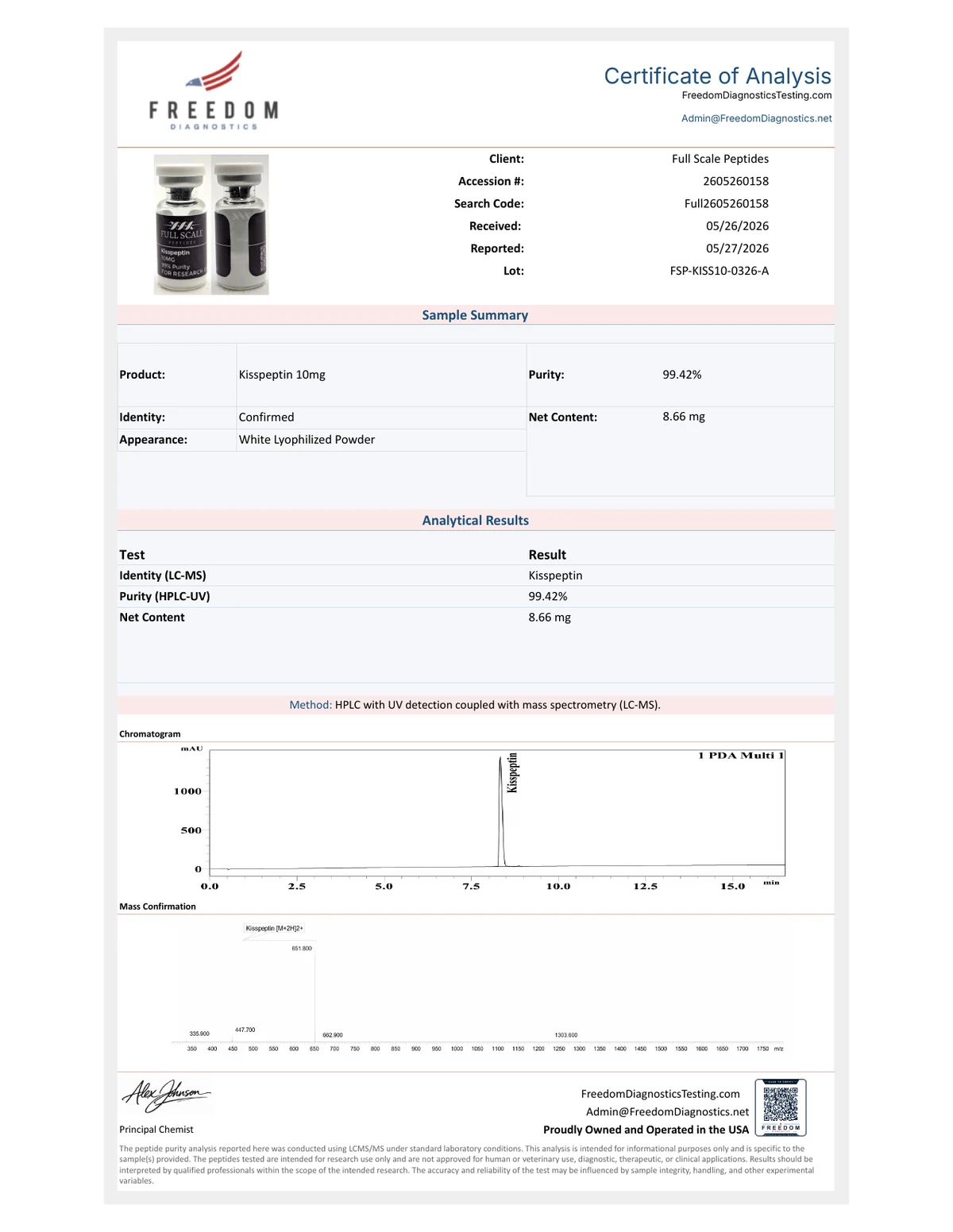
Kisspeptin research depends on precise dose-response curves, so the amount of intact peptide in the vial matters as much as its purity. Every Kisspeptin-10 lot from Full Scale Peptides is tested by an independent lab, Freedom Diagnostics, before it is sold. HPLC measures purity, LC-MS confirms the molecular identity, and the full report, including measured content, is published before you buy.
- Lot
- FSP-KISS10-0326-A
- Tested
- May 27, 2026
- Lab
- Freedom Diagnostics
- Measured content
- 8.66 mg (10 mg labeled)
- Accession #
- 2605260158
- Report
- View full COA
New to reading lab reports? See how to read and verify a Certificate of Analysis and why 99%+ purity matters in research.
How Kisspeptin-10 is handled in the lab
Kisspeptin-10 ships as a lyophilized (freeze-dried) powder, meaning the water has been removed to keep the peptide stable. Store sealed vials at −20 °C, protected from light. Before use in research it is reconstituted, or dissolved back into a liquid, usually with bacteriostatic water. Handling it the same careful way every time keeps results consistent:
- Let the sealed vial come to room temperature before opening it, to limit condensation.
- Add the water slowly down the inside wall of the vial, not directly onto the powder.
- Swirl gently until the powder is fully dissolved. Don’t shake it.
- Label the vial with the date, keep it refrigerated at 2–8 °C away from light, and avoid repeated freeze–thaw cycles.
For more detail, see our reconstitution guide and storage and handling best practices.
Key takeaways
- Kisspeptin-10 is a ten-amino-acid peptide, the shortest fully active form of kisspeptin, and it activates the KISS1 receptor (GPR54).
- It sits directly upstream of GnRH, making it a master regulator of the reproductive (HPG) axis.
- Loss of working KISS1R blocks normal puberty, a 2003 finding that transformed reproductive research.
- In controlled human research it stimulated LH release and increased LH pulse frequency. Newer work is exploring metabolic roles.
- Our current lot tests at 99.42% purity, with identity confirmed by LC-MS and the full COA published. For laboratory research use only.
Frequently asked questions
What is the difference between kisspeptin and Kisspeptin-10?
Kisspeptin is a family of peptides made from the KISS1 gene, ranging from 54 amino acids down to 10. Kisspeptin-10 is the shortest form and contains the ten amino acids needed to fully activate the receptor.
Why is it called kisspeptin?
The KISS1 gene was discovered in Hershey, Pennsylvania, home of Hershey's Kisses chocolates, and the name stuck. The longest form is also called metastin because the gene was first studied as a metastasis suppressor.
What does kisspeptin do in the body?
It activates GnRH neurons in the hypothalamus, which triggers the release of LH and FSH from the pituitary. That makes it a key controller of puberty and reproductive hormones.
What purity is Full Scale Peptides' Kisspeptin-10?
The current lot (FSP-KISS10-0326-A) measured 99.42% purity by HPLC, with identity confirmed by LC-MS at Freedom Diagnostics. The full Certificate of Analysis, including measured content, is published in our COA library.
How is Kisspeptin-10 supplied and stored?
It ships as a 10 mg lyophilized powder in a sealed glass vial. Store unopened vials at −20 °C away from light. Once reconstituted, keep the vial refrigerated at 2–8 °C.
Is Kisspeptin-10 for human or veterinary use?
No. It is sold strictly for laboratory research. It is not for human or veterinary use and must not be administered to people or animals.
Scientific references
The findings summarized on this page come from published scientific literature, available on PubMed. Full Scale Peptides did not conduct, fund or sponsor this research, and nothing here implies endorsement by the authors or their institutions. The studies describe research on kisspeptin itself, not the product we supply.
- Kotani M, Detheux M, Vandenbogaerde A, et al. The metastasis suppressor gene KiSS-1 encodes kisspeptins, the natural ligands of the orphan G protein-coupled receptor GPR54. J Biol Chem. 2001;276(37):34631–34636. PMID: 11457843
- Ohtaki T, Shintani Y, Honda S, et al. Metastasis suppressor gene KiSS-1 encodes peptide ligand of a G-protein-coupled receptor. Nature. 2001;411(6837):613–617. PMID: 11385580
- Seminara SB, Messager S, Chatzidaki EE, et al. The GPR54 gene as a regulator of puberty. N Engl J Med. 2003;349(17):1614–1627. PMID: 14573733
- de Roux N, Genin E, Carel JC, et al. Hypogonadotropic hypogonadism due to loss of function of the KiSS1-derived peptide receptor GPR54. Proc Natl Acad Sci U S A. 2003;100(19):10972–10976. PMID: 12944565
- George JT, Veldhuis JD, Roseweir AK, et al. Kisspeptin-10 is a potent stimulator of LH and increases pulse frequency in men. J Clin Endocrinol Metab. 2011;96(8):E1228–E1236. PMID: 21632807
Continue your research
For laboratory research use only. Not for human or veterinary use. The information on this page is provided for educational purposes and describes published research; it is not medical advice, and no statement here has been evaluated by the FDA.