
VIP (Vasoactive Intestinal Peptide): A Plain-English Research Guide
On this page
What is VIP?
VIP (Vasoactive Intestinal Peptide) is a naturally occurring 28-amino-acid neuropeptide. It was discovered in 1970 by Sami Said and Viktor Mutt, who isolated it from pig intestine because of its strong ability to widen blood vessels. That’s where the “vasoactive” in its name comes from.1
Despite the “intestinal” in its name, VIP turned out to be found throughout the body: in the brain, the gut, the lungs, the heart and the immune system. It belongs to the same peptide family as secretin, glucagon and PACAP, and it acts through two main receptors, VPAC1 and VPAC2.2 When VIP binds, the receptor activates an enzyme called adenylate cyclase and raises levels of the messenger cAMP inside the cell. The results include smooth-muscle relaxation, wider blood vessels and changes in immune-cell behavior.
VIP is a 28-amino-acid neuropeptide found throughout the body that is studied in laboratory research on immune regulation, the body clock, blood vessels and the lungs. Full Scale Peptides supplies it as a freeze-dried powder with a published COA, for research use only.
VIP at a glance
Amino acids
A mid-sized neuropeptide in the same family as secretin, glucagon and PACAP.
Discovered
Isolated from pig small intestine by Said and Mutt for its blood-vessel-widening activity.
Receptors
Two receptors that raise cAMP inside cells when VIP binds.
Our current lot
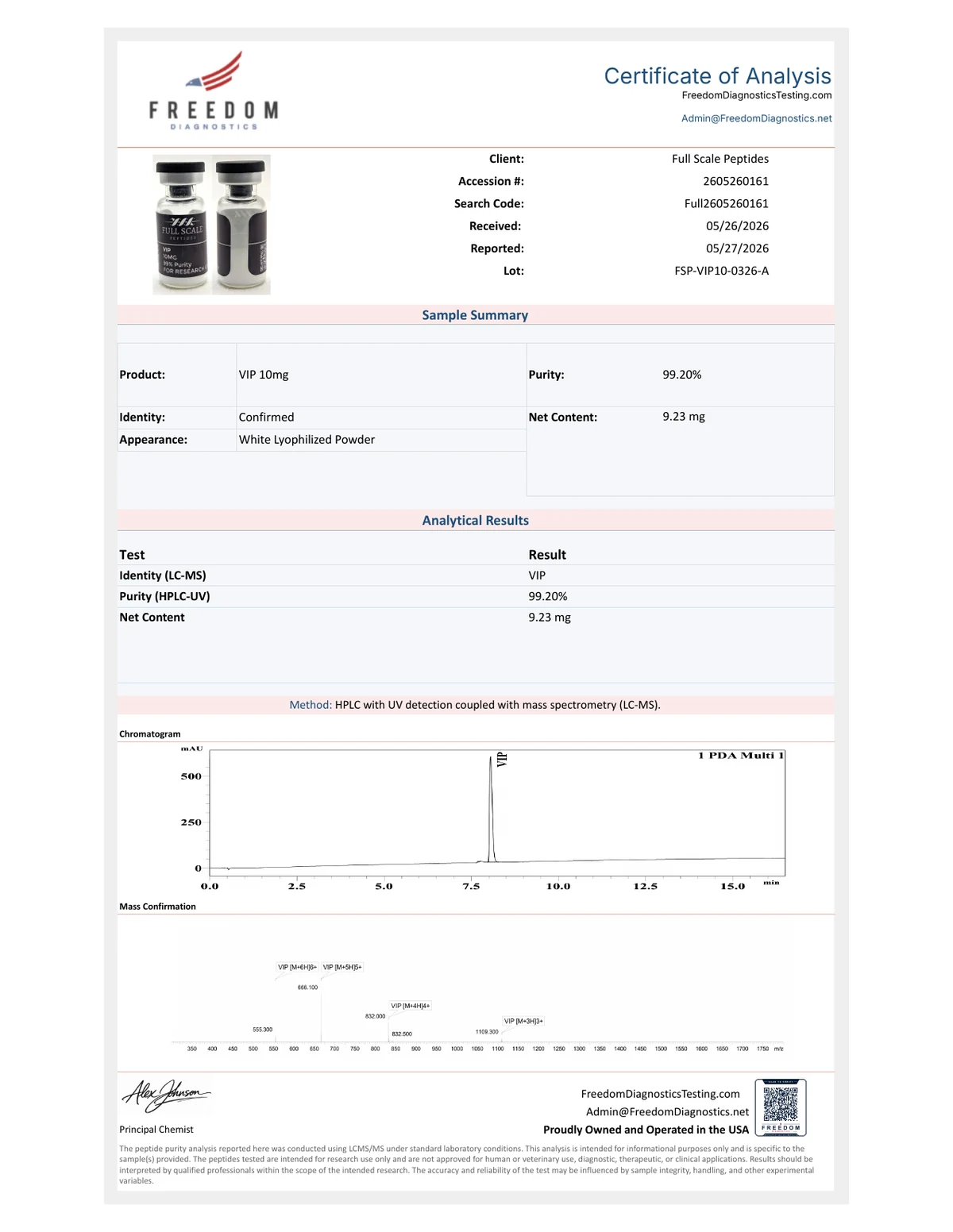
HPLC purity for lot FSP-VIP10-0326-A, with identity confirmed by LC-MS.
VIP and the immune system
VIP is one of the most studied links between the nervous system and the immune system. Immune cells carry VIP receptors, and some make VIP themselves. In laboratory research, VIP has shown strong anti-inflammatory effects:3
- It lowers production of pro-inflammatory signals (cytokines) by macrophages and other immune cells.
- It shifts immune responses from a Th1 (pro-inflammatory) toward a Th2 (anti-inflammatory) profile.
- It promotes the development of regulatory T cells, which help keep immune responses in check.
Because of these effects, VIP has been studied in animal models of inflammatory and autoimmune conditions, and in models of nerve-cell protection against inflammatory and oxidative damage.3
VIP and the body clock
The brain's master clock sits in a small region called the suprachiasmatic nucleus (SCN). Thousands of neurons there each keep their own rhythm, and VIP is one of the main signals that keeps them in sync. Mice that can't make VIP show disrupted daily rhythms in activity and sleep–wake timing.4 That makes VIP a key research tool for studying how the body clock stays coordinated.
Pulmonary research
VIP is abundant in the lungs, where it relaxes airway and blood-vessel smooth muscle. It is used in research models of pulmonary hypertension to study its effects on the blood vessels of the lungs. Mice lacking the VIP gene showed more pulmonary vascular remodeling and increased activity of inflammatory genes, which suggests VIP helps protect the lung's blood vessels.5
This page summarizes published laboratory and animal research on VIP. It does not promise any result and does not describe use in people or animals. VIP from Full Scale Peptides is sold strictly for laboratory research.
What scientists study VIP for
- Immune regulation. Cytokine signaling, T-cell balance and models of inflammatory disease.3
- Circadian rhythm. Synchronizing clock neurons in the SCN.4
- Blood vessels and lungs. Vasodilation and pulmonary vascular remodeling.5
- Neuroprotection. Protecting neurons from excitotoxicity, oxidative stress and inflammation in cell and animal models.3
- Receptor pharmacology. How VIP, PACAP and their shared receptors divide up their roles.2
VIP breaks down within minutes in the bloodstream, which limits how results from cell studies translate into whole-body models. Many findings come from animal research, and researchers treat them as leads rather than settled conclusions.
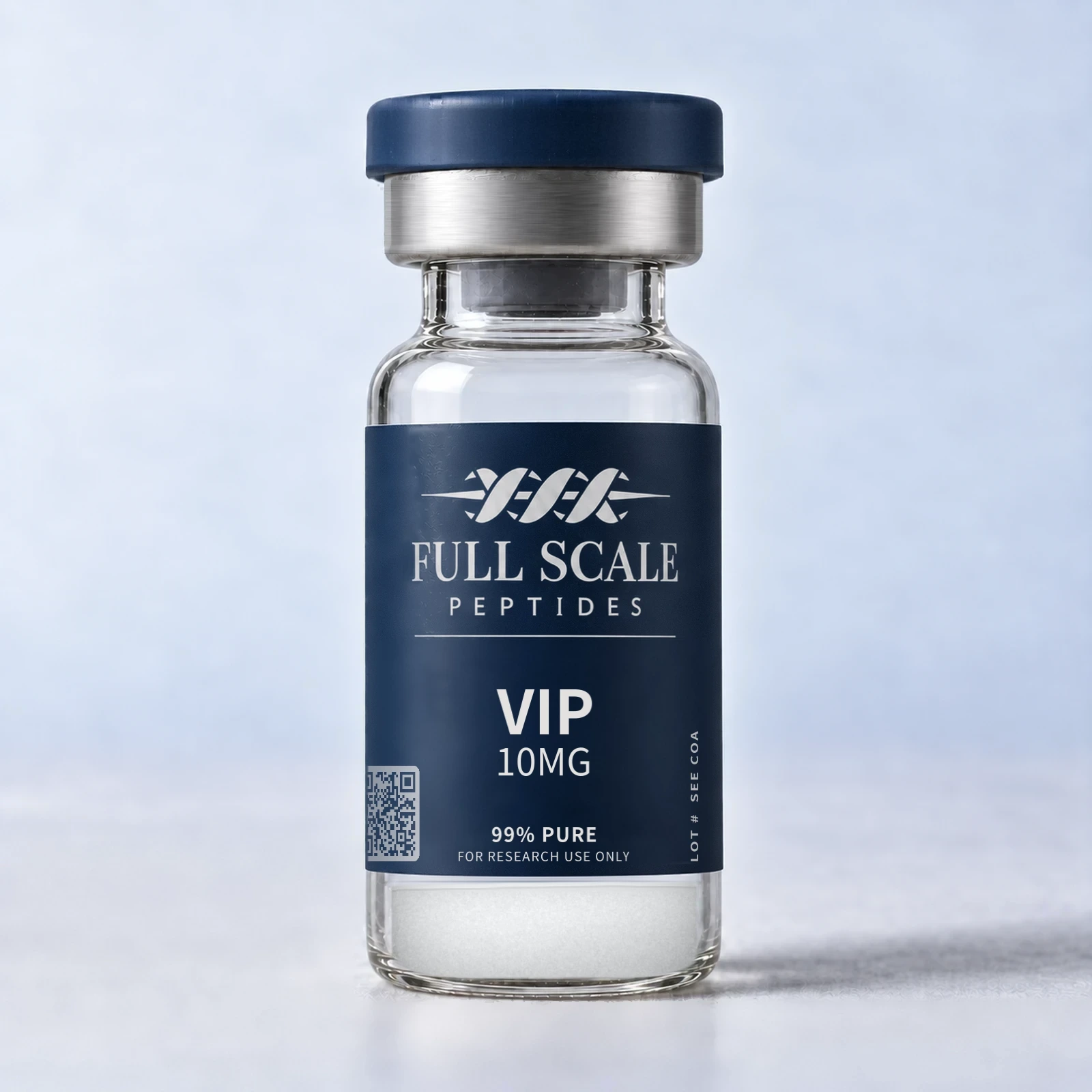
VIP 10mg, research grade
Freeze-dried powder with a third-party COA published before you buy, and tracked U.S. shipping. For laboratory research use only.
Purity and testing: why the COA matters
At 28 amino acids, VIP is long enough that incomplete sequences can slip into a synthesis, and they can look similar on a basic test. Every VIP lot from Full Scale Peptides is tested by an independent lab, Freedom Diagnostics, before it is sold. HPLC measures purity, LC-MS confirms the molecular identity, and the full report is published before you buy.
- Lot
- FSP-VIP10-0326-A
- Tested
- May 27, 2026
- Lab
- Freedom Diagnostics
- Measured content
- 9.23 mg (10 mg labeled)
- Accession #
- 2605260161
- Report
- View full COA
New to reading lab reports? See how to read and verify a Certificate of Analysis and why 99%+ purity matters in research.
How VIP is handled in the lab
VIP ships as a lyophilized (freeze-dried) powder, meaning the water has been removed to keep the peptide stable. Store sealed vials at −20 °C, protected from light. Before use in research it is reconstituted, or dissolved back into a liquid, usually with bacteriostatic water. Handling it the same careful way every time keeps results consistent:
- Let the sealed vial come to room temperature before opening it, to limit condensation.
- Add the water slowly down the inside wall of the vial, not directly onto the powder.
- Swirl gently until the powder is fully dissolved. Don’t shake it.
- Label the vial with the date, keep it refrigerated at 2–8 °C away from light, and avoid repeated freeze–thaw cycles.
For more detail, see our reconstitution guide and storage and handling best practices.
Key takeaways
- VIP is a 28-amino-acid neuropeptide, discovered in 1970 and found throughout the brain, gut, lungs and immune system.
- It acts through the VPAC1 and VPAC2 receptors, raising cAMP and relaxing smooth muscle.
- It is one of the most studied anti-inflammatory links between the nervous and immune systems.
- It helps keep the brain's master clock in sync and is studied in pulmonary hypertension models.
- Our current lot tests at 99.20% purity, with identity confirmed by LC-MS and the full COA published. For laboratory research use only.
Frequently asked questions
What does VIP stand for?
Vasoactive Intestinal Peptide. It was named for its ability to widen blood vessels and the fact that it was first isolated from the intestine.
Is VIP only found in the gut?
No. Despite its name, VIP is found in the brain, lungs, heart, gut and immune system, and it plays roles in each.
How does VIP affect the immune system?
In laboratory research, VIP reduces inflammatory signaling, shifts immune responses toward an anti-inflammatory profile and promotes regulatory T cells.
What purity is Full Scale Peptides' VIP?
The current lot (FSP-VIP10-0326-A) measured 99.20% purity by HPLC, with identity confirmed by LC-MS at Freedom Diagnostics. The full Certificate of Analysis is published in our COA library.
How is VIP supplied and stored?
It ships as a 10 mg lyophilized powder in a sealed glass vial. Store unopened vials at −20 °C away from light. Once reconstituted, keep the vial refrigerated at 2–8 °C.
Is VIP for human or veterinary use?
No. The VIP we supply is sold strictly for laboratory research. It is not for human or veterinary use and must not be administered to people or animals.
Scientific references
The findings summarized on this page come from published scientific literature, available on PubMed. Full Scale Peptides did not conduct, fund or sponsor this research, and nothing here implies endorsement by the authors or their institutions. The studies describe research on VIP itself, not the product we supply.
- Said SI, Mutt V. Polypeptide with broad biological activity: isolation from small intestine. Science. 1970;169(3951):1217–1218. PMID: 5450698
- Harmar AJ, Fahrenkrug J, Gozes I, et al. Pharmacology and functions of receptors for vasoactive intestinal peptide and pituitary adenylate cyclase-activating polypeptide: IUPHAR review 1. Br J Pharmacol. 2012;166(1):4–17. PMID: 22289055
- Delgado M, Pozo D, Ganea D. The significance of vasoactive intestinal peptide in immunomodulation. Pharmacol Rev. 2004;56(2):249–290. PMID: 15169929
- Colwell CS, Michel S, Itri J, et al. Disrupted circadian rhythms in VIP- and PHI-deficient mice. Am J Physiol Regul Integr Comp Physiol. 2003;285(5):R939–R949. PMID: 12855416
- Hamidi SA, Prabhakar S, Said SI. Enhancement of pulmonary vascular remodelling and inflammatory genes with VIP gene deletion. Eur Respir J. 2008;31(1):135–139. PMID: 18166594
Continue your research
For laboratory research use only. Not for human or veterinary use. The information on this page is provided for educational purposes and describes published research; it is not medical advice, and no statement here has been evaluated by the FDA.