
How to Read a Certificate of Analysis (COA)
On this page
What is a Certificate of Analysis?
A Certificate of Analysis (COA) is a lab report for one specific batch of a product. For research peptides, it answers three questions: Is this the right molecule? How pure is it? And how much is actually in the vial?
It is the single most important document in research-peptide buying. Peptides are white powders that all look the same, so the COA is the only practical way to know what you have before it goes into an experiment. Impure or mislabeled material doesn't just waste money. It can produce results that look real but aren't.3
This guide explains every part of a COA in plain English: how to read the two key tests, what other tests exist, and how to spot a fake. It's the place to start before reading anything else in our Research Library.
A COA is a batch-specific lab report that should prove three things: the peptide is what the label says (identity), how clean it is (purity) and how much is in the vial (content), from a named, independent lab you can verify.
A COA at a glance
Core tests
HPLC for purity and mass spectrometry for identity. A peptide COA without both is incomplete.
Batch per report
A COA only describes the lot that was tested, never “the product” in general.
Things it must prove
Right molecule, how pure, and how much is actually in the vial.
Months in prison
The 2026 sentence for a peptide seller whose company forged lab certificates.
The anatomy of a COA
Layouts vary from lab to lab, but a complete peptide COA contains the same eight pieces of information. Here is a simplified example with each part explained:
- Laboratory. Who ran the test. A real COA names an actual lab you can contact, not just the seller.
- Sample and lot. Which batch was tested. It must match the lot number printed on your vial.
- Method. How it was tested. For peptides, look for HPLC for purity and mass spectrometry (MS) for identity.
- Purity. The percentage of the sample that is the target peptide, from the HPLC result.
- Identity. Proof it is the right molecule: the measured mass should match the theoretical mass.
- Net content. How much peptide is actually in the vial, compared with what the label says.
- Date and sign-off. When it was tested and who approved it. Old reports may not match current stock.
- Accession number. The lab's own ID for the report, which lets the lab confirm it is genuine.
Want to see a real one? Here is one of ours for Semax, lot FSP-SEM-072126-01, with every field above filled in:
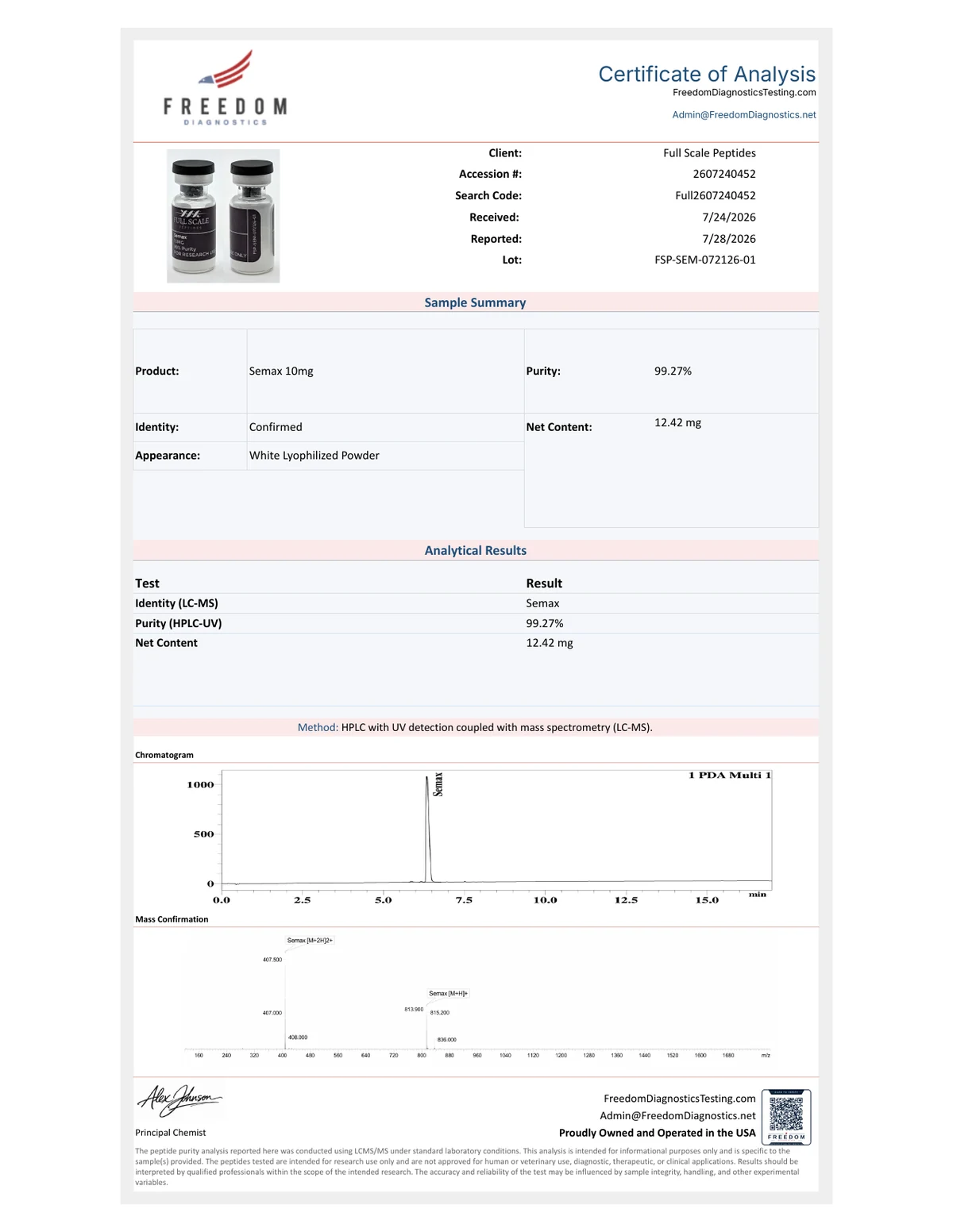
- Compound
- Semax 10mg
- Lot
- FSP-SEM-072126-01
- Purity
- 99.27% (HPLC)
- Content
- 12.42 mg (10 mg labeled)
- Lab
- Freedom Diagnostics
- Report
- Open full COA
Test 1: HPLC purity, explained
High-performance liquid chromatography (HPLC) is how purity is measured. The sample is dissolved and pushed through a narrow column packed with a special material. Different substances travel through the column at different speeds, so they come out one at a time. A detector records each one as a peak on a graph called a chromatogram.1
For peptides, the standard method is reverse-phase HPLC, usually with a C18 column and UV detection around 214–220 nm, the wavelength where the peptide bond absorbs light.12
How to read it
- One tall main peak should dominate. That's the target peptide.
- Small peaks on either side are impurities. Fewer and smaller is better.
- Purity % is the main peak's area divided by the total area of all peaks. A result of 99.27% means 0.73% of the UV signal came from something else.
- Retention time (where the main peak appears) should be consistent between batches of the same compound tested the same way.
HPLC purity is relative. It shows how much of what the detector can see is the target peptide, but it does not see water or salts, and it cannot prove the main peak is the right molecule. That's why purity alone is never enough. You also need identity (mass spec) and content.
Test 2: Mass spectrometry identity, explained
Mass spectrometry (MS) weighs molecules. Usually paired with HPLC as LC-MS, it measures the molecular mass of what's in the main peak and compares it with the peptide's known, theoretical mass. If they match, the identity is confirmed. If they don't, the vial holds something else, no matter how pure it looks on HPLC.
One thing confuses many first-time readers: the numbers on an MS readout are m/z (mass divided by charge), not plain mass. A peptide can pick up one, two or more extra protons, so the same molecule appears at several m/z values.
How to read it
- Find the theoretical mass of the peptide (the COA often lists it, or look up the sequence).
- Check that the observed mass matches it, allowing for small rounding differences.
- For a blend, each peptide in the vial should be identified separately.
Purity vs. net content: the most misunderstood part
Purity and content are different measurements. A vial can be 99% pure and still contain less peptide than the label says. That's why the best COAs report both.
| Measurement | What it answers | Example |
|---|---|---|
| Purity (HPLC %) | Of the peptide material, how much is the target molecule? | 99.27% |
| Net content (mg) | How much target peptide is physically in the vial? | 12.42 mg in a 10 mg vial |
| Identity (MS) | Is it the right molecule at all? | Observed mass matches theory |
Freeze-dried peptide powder isn't 100% peptide by weight. It also contains counter-ions left over from purification, such as trifluoroacetate (TFA) or acetate, plus a little bound water.4 Residual TFA matters in some experiments because it has been shown to affect cell growth in culture.5 A content measurement tells you how much real peptide you're working with, which is essential for accurate concentrations.
Content can come in slightly above the label. For example, most of our recent lots measure roughly 10–30% over the labeled amount. It can also come in below. Either way, a published content figure lets you calculate precisely instead of assuming.
What the impurities actually are
Research peptides are made by solid-phase peptide synthesis, which builds the chain one amino acid at a time. Each step is highly efficient but not perfect, so the finished product can contain related impurities:4
- Deletion sequences: one amino acid missing from the chain.
- Truncated sequences: chains that stopped growing early.
- Incomplete deprotection: leftover chemical protecting groups.
- Oxidation: especially of methionine or tryptophan.
- Deamidation: changes to asparagine or glutamine over time.
- Racemization: an amino acid flipped to its mirror-image form.
These aren't just cosmetic. In one study of commercial synthetic peptides, impurities and cross-contamination were enough to produce false-positive results in immune assays.3 High purity and confirmed identity are what protect your data from that.
Other tests you may see on a COA
Purity, identity and content are the core. Some reports include additional panels, which are worth knowing about:
- Endotoxin (LAL test): bacterial toxins that can interfere with cell and immune experiments.
- Sterility: whether microorganisms are present.
- Heavy metals: lead, arsenic, mercury and cadmium.
- Residual solvents: chemicals left over from synthesis.
- Water content (Karl Fischer): how much moisture is in the powder.
- Amino acid analysis: an alternative way to measure peptide content.
Regulatory guidance for pharmaceutical peptides describes how these specifications fit together.2 For research use, purity, identity and content are the essentials, and the extra panels are a bonus. Our current reports cover the three essentials: HPLC purity, identity confirmation and measured content.
In-house vs. third-party COAs
- Manufacturer or in-house COA: produced by the company that made or sells the product. Useful, but it has a built-in conflict of interest.
- Third-party COA: produced by an independent lab with no stake in the result. This is the standard serious buyers look for.
- Accredited lab: labs accredited to ISO/IEC 17025, the international standard for testing-lab competence, have been independently audited on their methods and quality systems. It's a reasonable question to ask any supplier about their lab.
How to spot a fake or weak COA
Fake COAs are a real problem. In July 2026, the owner of Paradigm Peptides was sentenced to 70 months in federal prison. Among other things, his company forged lab certificates to create false credibility while advertising “99% purity” and third-party testing.† Watch for these warning signs:
This guide explains how to evaluate laboratory documentation for research materials. It does not describe any use of peptides in people or animals. All Full Scale Peptides products are sold strictly for laboratory research.
How to verify a Full Scale Peptides COA in 5 steps
- Find the lot number printed on your vial, or scan the QR code on the label.
- Open our COA library and search that lot number. Every lot is published before it goes on sale.
- Check that HPLC purity, identity and measured content are all reported for that lot.
- Note the lab name (Freedom Diagnostics) and the accession number on the report.
- Want independent confirmation? Contact the lab with the accession number, or contact us and we'll help you verify it.
Glossary
- Accession number
- The lab's unique ID for a report, used to verify it.
- Area %
- How HPLC purity is calculated: the main peak's share of total peak area.
- Chromatogram
- The HPLC graph showing each substance as a peak.
- Counter-ion
- A salt (such as TFA or acetate) bound to the peptide after purification.
- LC-MS
- Liquid chromatography combined with mass spectrometry, used to confirm identity.
- Lot / batch
- One production run. Every COA applies to one lot only.
- Lyophilized
- Freeze-dried into a stable powder.
- m/z
- Mass divided by charge, the unit on a mass spectrum.
- Net content
- The measured amount of peptide in the vial, in mg.
- Retention time
- When a substance leaves the HPLC column; a fingerprint for that method.
Key takeaways
- A COA should prove three things: identity (mass spec), purity (HPLC) and net content.
- Purity alone is not enough. A pure sample of the wrong molecule, or a half-filled vial, can still pass an HPLC test.
- The lot number on the COA must match your vial, and the report should come from a named, independent lab.
- Impurities from synthesis can produce false results, which is why verified material matters.
- Every Full Scale Peptides lot is published in our COA library before sale, with purity, identity and content. For laboratory research use only.
Frequently asked questions
What does COA stand for?
Certificate of Analysis: a lab report showing test results for one specific batch of a product.
What is a good purity for a research peptide?
Research-grade peptides are commonly specified at 98% or higher by HPLC, and many suppliers aim for 99%+. Purity should always be paired with an identity test.
Why is the measured content higher than the label?
Vials are often filled slightly above the labeled amount to make sure researchers never receive less. Most of our recent lots measure roughly 10–30% over label, and every COA shows the exact figure.
Is a 99% purity number enough on its own?
No. HPLC purity does not prove identity and does not show how much peptide is in the vial. Look for mass-spec identity and net content too.
How do I know a COA is real?
Check for a named lab, a lot number that matches your vial, a chromatogram and mass data, a recent date and an accession number you can verify with the lab.
Where are Full Scale Peptides' COAs?
Every published report is in our COA library, searchable by compound, lot or accession number.
Scientific references
The findings summarized on this page come from published scientific literature, available on PubMed. Full Scale Peptides did not conduct, fund or sponsor this research, and nothing here implies endorsement by the authors or their institutions. The studies describe research on peptide analysis and quality itself, not the product we supply.
- Aguilar MI. Reversed-phase high-performance liquid chromatography. Methods Mol Biol. 2004;251:9–22. PMID: 14704435
- Vergote V, Burvenich C, Van de Wiele C, De Spiegeleer B. Quality specifications for peptide drugs: a regulatory-pharmaceutical approach. J Pept Sci. 2009;15(11):697–710. PMID: 19750489
- Currier JR, Galley LM, Wenschuh H, et al. Peptide impurities in commercial synthetic peptides and their implications for vaccine trial assessment. Clin Vaccine Immunol. 2008;15(2):267–276. PMID: 18077621
- D'Hondt M, Bracke N, Taevernier L, et al. Related impurities in peptide medicines. J Pharm Biomed Anal. 2014;101:2–30. PMID: 25044089
- Cornish J, Callon KE, Lin CQ, et al. Trifluoroacetate, a contaminant in purified proteins, inhibits proliferation of osteoblasts and chondrocytes. Am J Physiol. 1999;277(5):E779–E783. PMID: 10567002
† News source: CBS News, “Judge sentences peptide vendor to nearly 6 years in prison” (July 2026). Read the article
Continue your research
For laboratory research use only. Not for human or veterinary use. The information on this page is provided for educational purposes and describes published research; it is not medical advice, and no statement here has been evaluated by the FDA.