
Tesamorelin: A Plain-English Research Guide
On this page
What is Tesamorelin?
Tesamorelin is a synthetic version of growth hormone–releasing hormone (GHRH), the brain signal that tells the pituitary gland to release growth hormone. It contains all 44 amino acids of human GHRH with one addition: a small trans-3-hexenoyl group attached to the first amino acid (tyrosine).
That one change matters. Natural GHRH is broken down within minutes by an enzyme called DPP-4. The hexenoyl group blocks that enzyme while keeping full activity at the GHRH receptor, so tesamorelin lasts much longer.
Tesamorelin is unusual among research peptides because it went through full pharmaceutical development. It was approved by the FDA in 2010 as Egrifta for one specific clinical use, which means it comes with a large body of human clinical data.12 For researchers, that makes it a kind of reference compound for GHRH-analog work.
Tesamorelin is a stabilized, full-length copy of GHRH that stimulates the body's own pulsatile growth-hormone release, and it has some of the strongest human data of any peptide in its class. Full Scale Peptides supplies it as a freeze-dried powder with a published COA, for research use only.
Tesamorelin at a glance
Amino acids
The complete human GHRH sequence, stabilized by a single modification at the N-terminus.
FDA approval
Approved as Egrifta for a specific clinical indication after large phase 3 trials.
Resistance
The hexenoyl group protects it from the enzyme that breaks down natural GHRH in minutes.
Our current lot
HPLC purity for lot FSP-TESAMO-0126-A, with identity confirmed by LC-MS.
How the molecule is designed
Tesamorelin and CJC-1295 (No DAC) solve the same problem in different ways. CJC-1295 shortens GHRH to its first 29 amino acids and stabilizes that fragment with four amino-acid substitutions. Tesamorelin keeps the full 44-amino-acid sequence and adds one hexenoyl group to the front. Comparing the two approaches is a recurring theme in GHRH research.
Tesamorelin also acts through a different pathway than growth-hormone secretagogues such as Ipamorelin. Ipamorelin works on the ghrelin receptor, while tesamorelin works on the GHRH receptor, the primary pathway the body uses to trigger growth-hormone release.
What the research looks at
1. Natural, pulsatile growth-hormone release
Because tesamorelin works through the body's own GHRH receptor, growth hormone is still released in natural pulses and stays under normal feedback control. Somatostatin still acts as the brake, and IGF-1 still feeds back on the system. This is different from research with growth hormone itself, which bypasses the axis entirely.
2. IGF-1 and visceral fat
The phase 3 program, led by Falutz and colleagues, reported that tesamorelin reduced visceral (deep abdominal) fat in HIV-associated lipodystrophy over 26 to 52 weeks, along with increases in IGF-1.12 These trials are among the best-controlled datasets on what sustained GHRH-receptor stimulation does to fat stores and metabolic markers in humans.
3. Liver fat
Later randomized trials by Stanley and colleagues reported reductions in liver fat and, in a follow-up trial, slower progression of liver fibrosis in HIV-associated fatty liver disease.34 That extended tesamorelin's research role from visceral fat to liver metabolism.
4. Cognition
A separate randomized trial by Baker and colleagues examined GHRH treatment in older adults, with and without mild cognitive impairment, and reported favorable effects on measures of executive function.5 This literature is smaller and more debated.
The strongest trials were run in specific populations, mainly people with HIV-associated fat accumulation, and results do not automatically apply elsewhere. Body-composition changes reversed after treatment stopped. IGF-1 increases are expected and are treated as something to monitor. Most importantly, the clinical data describe the pharmaceutical product used under medical supervision, not research-grade material.
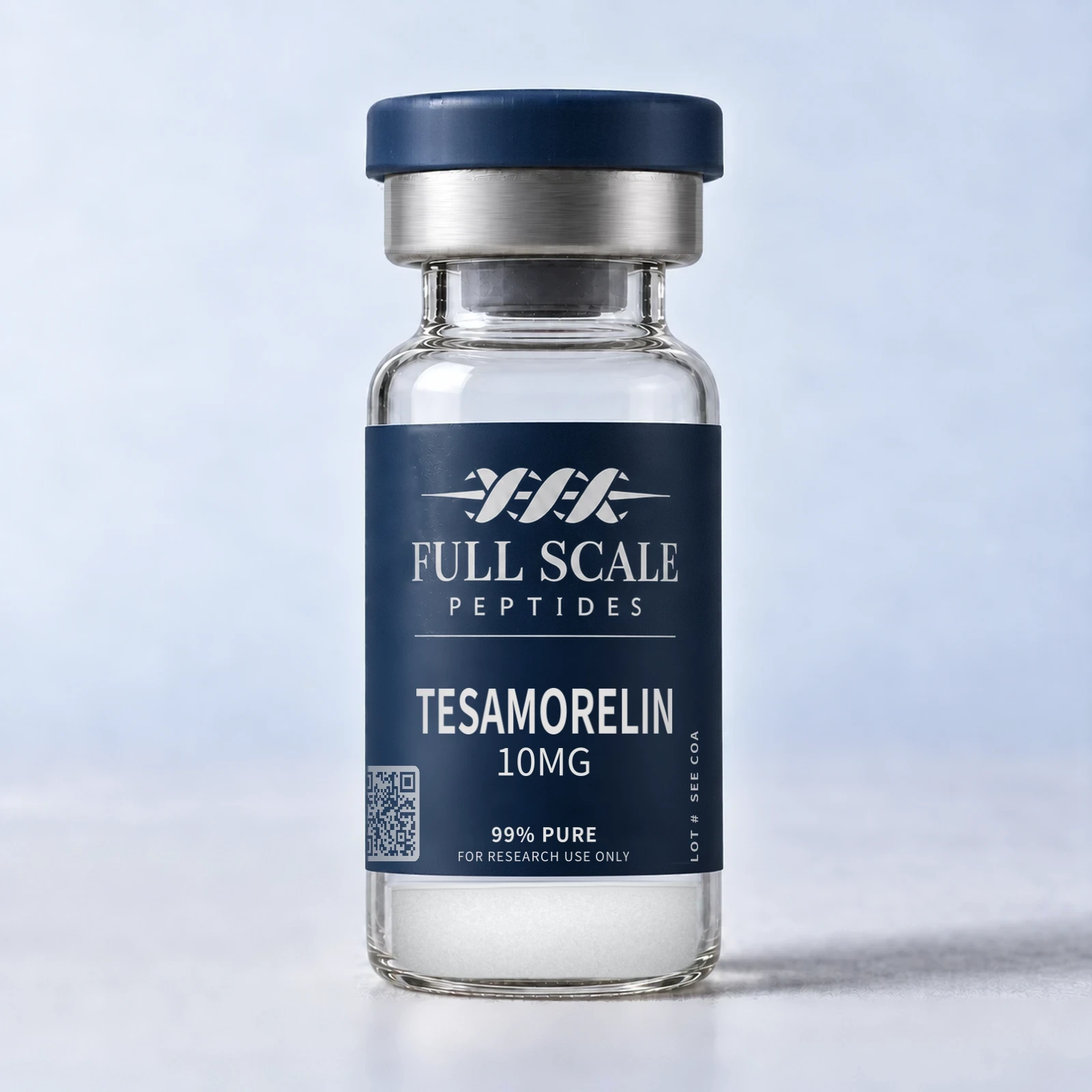
Tesamorelin 10mg, research grade
Freeze-dried powder with a third-party COA published before you buy, and tracked U.S. shipping. For laboratory research use only.
Purity and testing: why the COA matters
Research-grade tesamorelin shares the molecule, not the pharmaceutical manufacturing process, which is exactly why independent testing matters. Every lot from Full Scale Peptides is tested by Freedom Diagnostics before it is sold. HPLC measures purity, and LC-MS confirms the identity, including the hexenoyl modification that separates tesamorelin from unmodified GHRH. The full report is published before you buy.
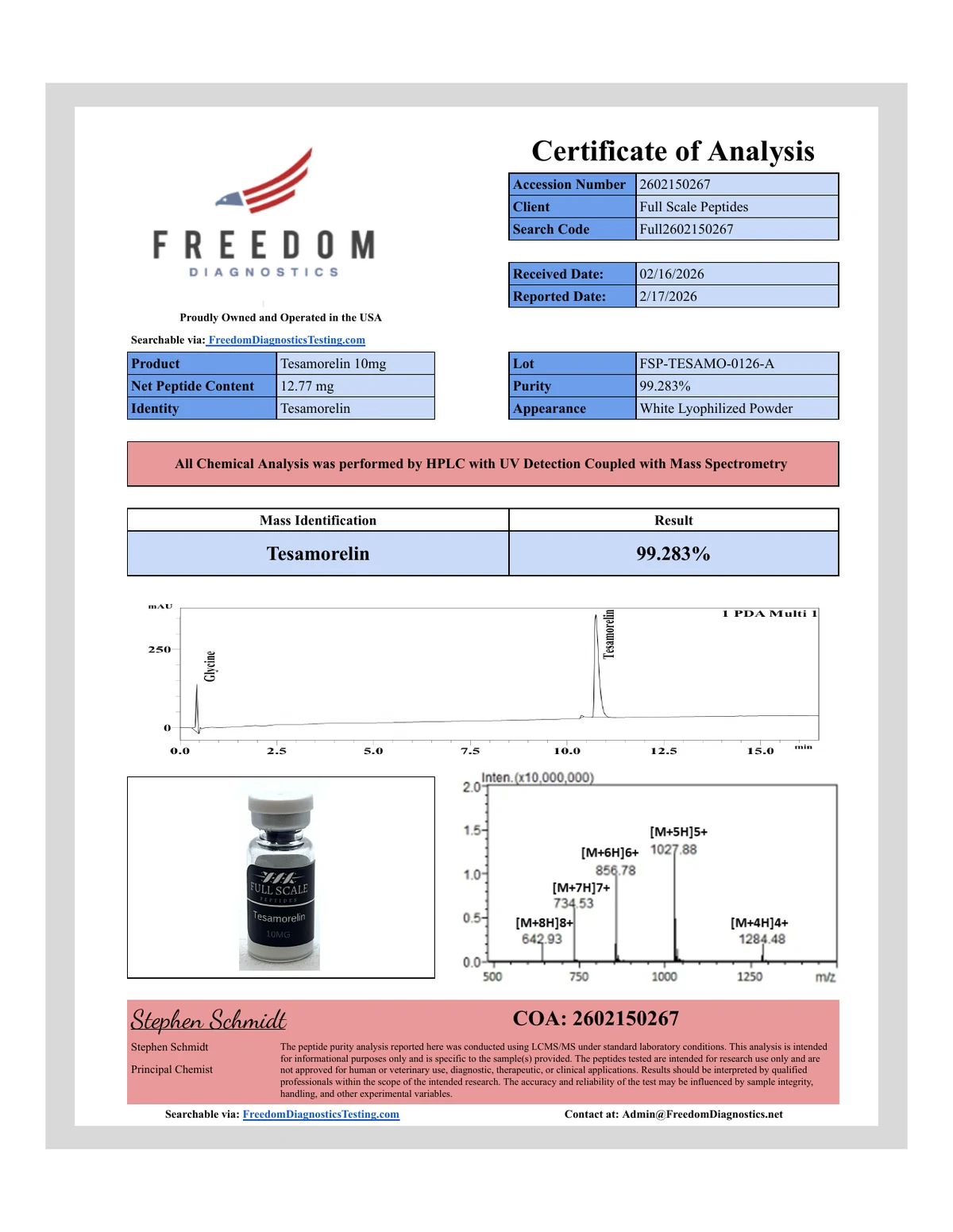
- Lot
- FSP-TESAMO-0126-A
- Tested
- Feb 17, 2026
- Lab
- Freedom Diagnostics
- Measured content
- 12.77 mg (10 mg labeled)
- Accession #
- 2602150267
- Report
- View full COA
New to reading lab reports? See how to read and verify a Certificate of Analysis and why 99%+ purity matters in research.
How Tesamorelin is handled in the lab
Tesamorelin ships as a lyophilized (freeze-dried) powder, meaning the water has been removed to keep the peptide stable. Store sealed vials at −20 °C, protected from light and moisture. Before use in research it is reconstituted, or dissolved back into a liquid, usually with bacteriostatic water. Handling it the same careful way every time keeps results consistent:
- Let the sealed vial come to room temperature before opening it, to limit condensation.
- Add the water slowly down the inside wall of the vial, not directly onto the powder.
- Swirl gently until the powder is fully dissolved. Don’t shake it.
- Label the vial with the date, keep it refrigerated at 2–8 °C away from light, and avoid repeated freeze–thaw cycles.
For more detail, see our reconstitution guide and storage and handling best practices.
Key takeaways
- Tesamorelin is a full-length, stabilized copy of GHRH, protected from DPP-4 breakdown by one hexenoyl group.
- It stimulates the body's own pulsatile growth-hormone release through the GHRH receptor, keeping normal feedback in place.
- Phase 3 and later randomized trials reported reductions in visceral fat and liver fat, making it a reference compound for GH-axis research.
- The human data are strong but population-specific, and effects reversed after treatment stopped.
- Our current lot tests at 99.28% purity, with identity confirmed by LC-MS and the full COA published. For laboratory research use only.
Frequently asked questions
How is tesamorelin different from growth hormone?
Growth hormone bypasses the body's control system. Tesamorelin stimulates the pituitary to release its own growth hormone in natural pulses, which keeps normal feedback in place.
How is tesamorelin different from CJC-1295?
Both are stabilized GHRH analogs. CJC-1295 (No DAC) uses a shortened 29-amino-acid fragment with four substitutions, while tesamorelin keeps all 44 amino acids and adds one hexenoyl group.
Is research-grade tesamorelin the same as Egrifta?
It is the same molecule, but not the same manufacturing process or product. The clinical data describe the pharmaceutical product used under medical supervision.
What purity is Full Scale Peptides' Tesamorelin?
The current lot (FSP-TESAMO-0126-A) measured 99.28% purity by HPLC, with identity confirmed by LC-MS at Freedom Diagnostics. The full Certificate of Analysis is published in our COA library.
How is Tesamorelin supplied and stored?
It ships as a 10 mg lyophilized powder in a sealed glass vial. Store unopened vials at −20 °C away from light and moisture. Once reconstituted, keep the vial refrigerated at 2–8 °C.
Is Tesamorelin for human or veterinary use?
No. The tesamorelin we supply is sold strictly for laboratory research. It is not for human or veterinary use and must not be administered to people or animals.
Scientific references
The findings summarized on this page come from published scientific literature, available on PubMed. Full Scale Peptides did not conduct, fund or sponsor this research, and nothing here implies endorsement by the authors or their institutions. The studies describe research on tesamorelin itself, not the product we supply.
- Falutz J, Allas S, Blot K, et al. Metabolic effects of a growth hormone-releasing factor in patients with HIV. N Engl J Med. 2007;357(23):2359–2370. PMID: 18057338
- Falutz J, Mamputu JC, Potvin D, et al. Effects of tesamorelin (TH9507), a growth hormone-releasing factor analog, in human immunodeficiency virus-infected patients with excess abdominal fat: a pooled analysis of two multicenter, double-blind placebo-controlled phase 3 trials with safety extension data. J Clin Endocrinol Metab. 2010;95(9):4291–4304. PMID: 20554713
- Stanley TL, Feldpausch MN, Oh J, et al. Effect of tesamorelin on visceral fat and liver fat in HIV-infected patients with abdominal fat accumulation: a randomized clinical trial. JAMA. 2014;312(4):380–389. PMID: 25038357
- Stanley TL, Fourman LT, Feldpausch MN, et al. Effects of tesamorelin on non-alcoholic fatty liver disease in HIV: a randomised, double-blind, multicentre trial. Lancet HIV. 2019;6(12):e821–e830. PMID: 31611038
- Baker LD, Barsness SM, Borson S, et al. Effects of growth hormone-releasing hormone on cognitive function in adults with mild cognitive impairment and healthy older adults: results of a controlled trial. Arch Neurol. 2012;69(11):1420–1429. PMID: 22869065
Continue your research
For laboratory research use only. Not for human or veterinary use. The information on this page is provided for educational purposes and describes published research; it is not medical advice, and no statement here has been evaluated by the FDA.