
GHK-Cu (Copper Peptide): A Plain-English Research Guide
On this page
What is GHK-Cu?
GHK-Cu is a small peptide made of just three amino acids, glycine, histidine and lysine (Gly-His-Lys), bound to a copper ion. The peptide, called GHK, grabs copper very tightly, and the copper gives the complex its distinctive blue color.
GHK was first isolated from human blood plasma in 1973 by Loren Pickart, who noticed it helped liver cells survive in culture.1 It occurs naturally in plasma, saliva and urine, and its level in blood falls substantially with age. That decline is a big reason researchers became interested in what GHK-Cu does in tissue repair and skin biology.2
GHK-Cu is a naturally occurring three-amino-acid peptide bound to copper, studied in laboratory research on collagen production, wound remodeling, skin biology and gene expression. Full Scale Peptides supplies it as a blue freeze-dried powder with a published COA, for research use only.
GHK-Cu at a glance
Amino acids
Gly-His-Lys, one of the smallest signaling peptides known, bound to a copper(II) ion.
First isolated
Discovered in human plasma by Loren Pickart for its effect on liver-cell survival.
Color
The copper complex is naturally blue, which is why GHK-Cu powder is blue rather than white.
Our current lot
HPLC purity for lot FSP-GHKCU-0126-A, with identity confirmed by LC-MS.
Two jobs in one molecule
Researchers describe GHK-Cu as doing two different things:
- Delivering copper. Copper is essential for several enzymes that build and protect tissue, including lysyl oxidase (which cross-links collagen and elastin), superoxide dismutase (an antioxidant enzyme) and cytochrome c oxidase (cell energy). GHK is studied as a natural way to carry copper to cells in a usable, non-toxic form.2
- Sending signals. Separately from copper delivery, the peptide itself appears to act as a signal. Gene-expression analyses reported that GHK shifts the activity of a large number of human genes in directions the authors describe as regenerative and protective.56
What the research shows
1. Collagen production
The foundational finding came in 1988: GHK-Cu stimulated collagen synthesis in cultured skin cells (fibroblasts) at very low concentrations.3 Later work extended this to other parts of the tissue scaffolding, including glycosaminoglycans and small proteoglycans, and to the enzymes that break the scaffolding down. That’s why GHK-Cu is described as a remodeling signal, not just a builder.2
2. Wound models
In rat wound models, GHK-Cu increased the build-up of connective tissue in the wound and improved how it was organized.4 Other animal studies reported faster closure and more new blood vessels.
3. Hair follicle models
In lab-grown human hair follicles, a copper tripeptide complex stimulated follicle growth and the activity of dermal papilla cells, the cells that control hair growth.7
4. Antioxidant and anti-inflammatory signaling
Cell studies have reported reductions in inflammatory signals and oxidative-stress markers, with a proposed link to copper's role in the antioxidant enzyme superoxide dismutase.2
This page summarizes published laboratory and animal research. It does not describe any cosmetic product or any use in people or animals. GHK-Cu from Full Scale Peptides is sold strictly for laboratory research.
A large share of the GHK-Cu literature, including the foundational collagen paper and the broad gene-expression claims, involves Loren Pickart and close collaborators, so independent replication of the widest claims is limited. Much of the work is in cell culture, and several studies report that effects change at higher concentrations, which makes concentration a key experimental variable.
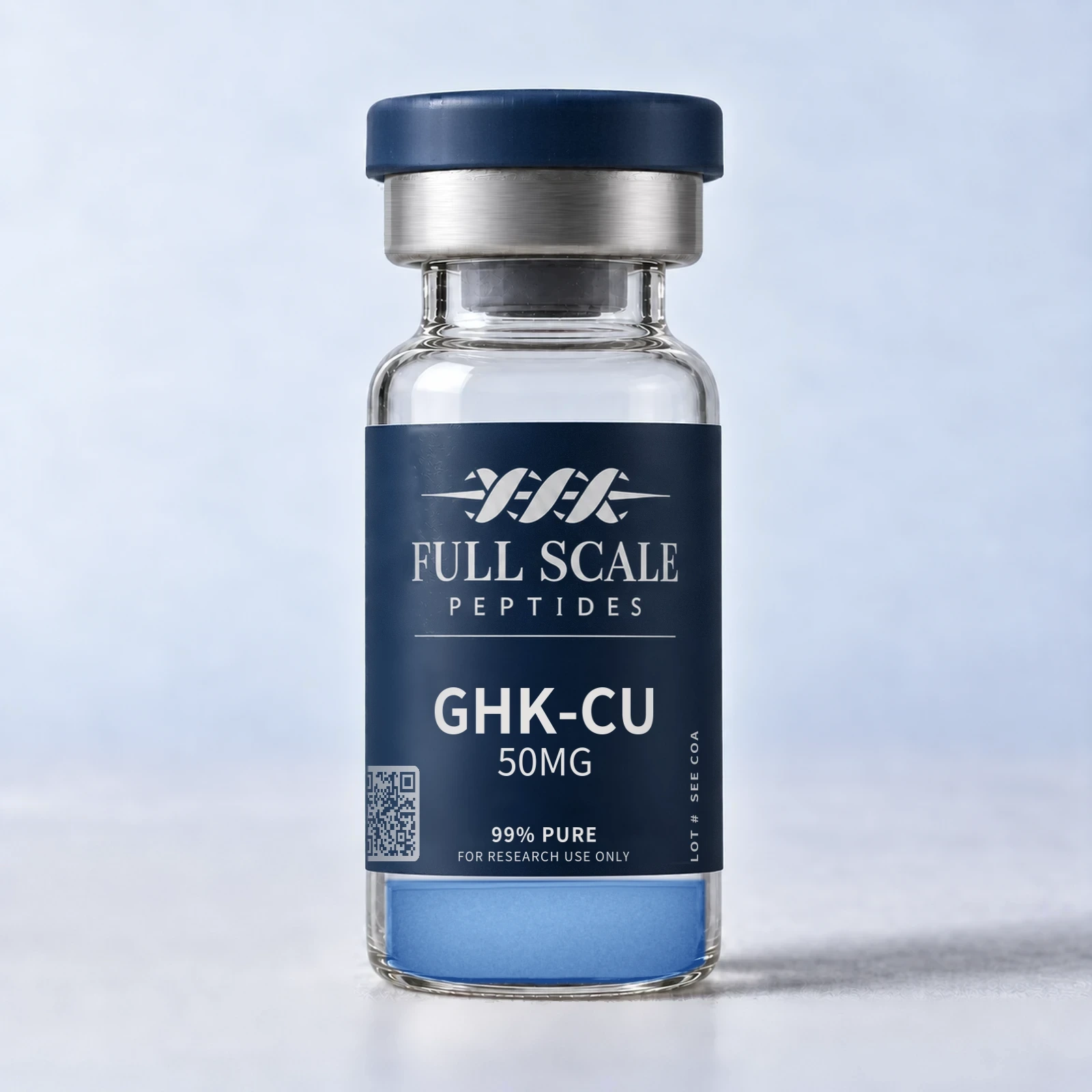
GHK-Cu 50mg, research grade
Freeze-dried powder with a third-party COA published before you buy, and tracked U.S. shipping. For laboratory research use only.
Purity and testing: why the COA matters
Copper-peptide complexes need careful quality control. The blue color alone doesn't prove the right peptide is present or in the right amount. Every GHK-Cu lot from Full Scale Peptides is tested by an independent lab, Freedom Diagnostics, before it is sold. HPLC measures purity, LC-MS confirms the peptide's identity, and the full report is published before you buy.
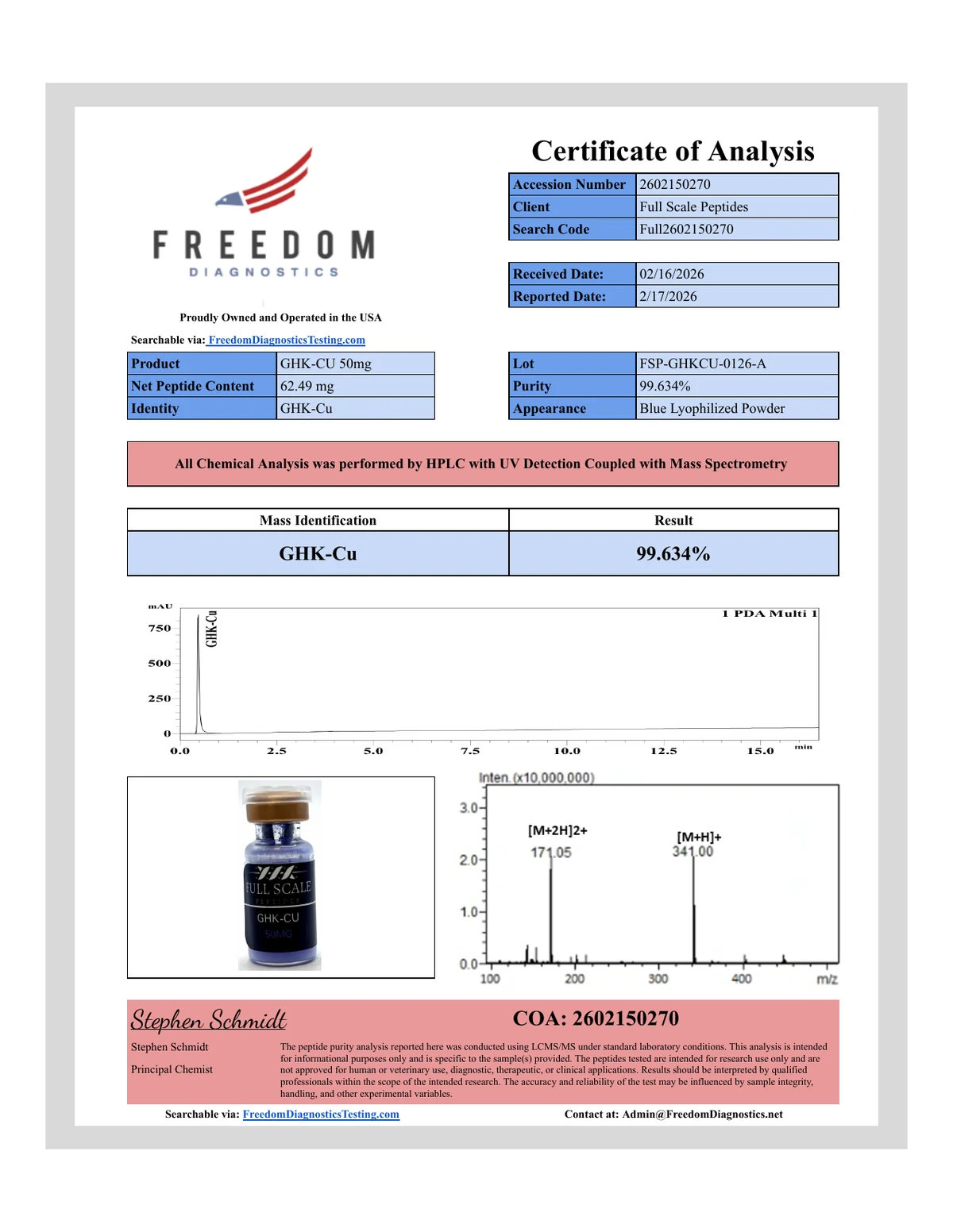
- Lot
- FSP-GHKCU-0126-A
- Tested
- Feb 17, 2026
- Lab
- Freedom Diagnostics
- Measured content
- 62.49 mg (50 mg labeled)
- Accession #
- 2602150270
- Report
- View full COA
New to reading lab reports? See how to read and verify a Certificate of Analysis and why 99%+ purity matters in research.
How GHK-Cu is handled in the lab
GHK-Cu ships as a lyophilized (freeze-dried) powder, meaning the water has been removed to keep the peptide stable. Store sealed vials at −20 °C, protected from light. Before use in research it is reconstituted, or dissolved back into a liquid, usually with bacteriostatic water. Handling it the same careful way every time keeps results consistent:
- Let the sealed vial come to room temperature before opening it, to limit condensation.
- Add the water slowly down the inside wall of the vial, not directly onto the powder.
- Swirl gently until the powder is fully dissolved. Don’t shake it.
- Label the vial with the date, keep it refrigerated at 2–8 °C away from light, and avoid repeated freeze–thaw cycles.
For more detail, see our reconstitution guide and storage and handling best practices.
The copper complex behaves a little differently from plain peptides in solution. Our GHK-Cu stability and reconstitution guide covers the details. GHK-Cu is also available with BPC-157 and TB-500 as our GLOW Blend.
Key takeaways
- GHK-Cu is a three-amino-acid peptide (Gly-His-Lys) bound to copper, first isolated from human plasma in 1973.
- It acts as both a copper carrier for tissue-building enzymes and a signaling peptide.
- Research links it to collagen production, wound remodeling, hair-follicle activity and changes in gene expression.
- The widest claims come from a small group of researchers and need more independent replication.
- Our current lot tests at 99.63% purity, with identity confirmed by LC-MS and the full COA published. For laboratory research use only.
Frequently asked questions
Why is GHK-Cu blue?
The copper(II) ion bound to the peptide gives the complex its blue color. Plain GHK without copper is white.
What does GHK stand for?
It stands for its three amino acids: glycine (G), histidine (H) and lysine (K). “Cu” is the chemical symbol for copper.
What is GHK-Cu studied for?
Mainly collagen production, wound remodeling, skin biology, hair follicle models and gene expression, in cell and animal research.
What purity is Full Scale Peptides' GHK-Cu?
The current lot (FSP-GHKCU-0126-A) measured 99.63% purity by HPLC, with identity confirmed by LC-MS at Freedom Diagnostics. The full Certificate of Analysis is published in our COA library.
How is GHK-Cu supplied and stored?
It ships as a 50 mg lyophilized blue powder in a sealed glass vial. Store unopened vials at −20 °C away from light. Once reconstituted, keep the vial refrigerated at 2–8 °C.
Is GHK-Cu for human or veterinary use?
No. The GHK-Cu we supply is sold strictly for laboratory research. It is not for human, veterinary or cosmetic use and must not be administered to people or animals.
Scientific references
The findings summarized on this page come from published scientific literature, available on PubMed. Full Scale Peptides did not conduct, fund or sponsor this research, and nothing here implies endorsement by the authors or their institutions. The studies describe research on GHK-Cu itself, not the product we supply.
- Pickart L, Thaler MM. Tripeptide in human serum which prolongs survival of normal liver cells and stimulates growth in neoplastic liver. Nat New Biol. 1973;243(124):85–87. PMID: 4349963
- Pickart L. The human tri-peptide GHK and tissue remodeling. J Biomater Sci Polym Ed. 2008;19(8):969–988. PMID: 18644225
- Maquart FX, Pickart L, Laurent M, et al. Stimulation of collagen synthesis in fibroblast cultures by the tripeptide-copper complex glycyl-L-histidyl-L-lysine-Cu2+. FEBS Lett. 1988;238(2):343–346. PMID: 3169264
- Maquart FX, Bellon G, Chaqour B, et al. In vivo stimulation of connective tissue accumulation by the tripeptide-copper complex glycyl-L-histidyl-L-lysine-Cu2+ in rat experimental wounds. J Clin Invest. 1993;92(5):2368–2376. PMID: 8227353
- Pickart L, Vasquez-Soltero JM, Margolina A. GHK peptide as a natural modulator of multiple cellular pathways in skin regeneration. Biomed Res Int. 2015;2015:648108. PMID: 26236730
- Pickart L, Margolina A. Regenerative and protective actions of the GHK-Cu peptide in the light of the new gene data. Int J Mol Sci. 2018;19(7). PMID: 29986520
- Pyo HK, Yoo HG, Won CH, et al. The effect of tripeptide-copper complex on human hair growth in vitro. Arch Pharm Res. 2007;30(7):834–839. PMID: 17703734
Continue your research
For laboratory research use only. Not for human or veterinary use. The information on this page is provided for educational purposes and describes published research; it is not medical advice, and no statement here has been evaluated by the FDA.