
CJC-1295 (No DAC) & Ipamorelin: A Plain-English Research Guide
On this page
Two peptides, one system
Growth hormone (GH) is released in pulses, controlled by signals from the brain. Two research peptides map directly onto that control system:
- CJC-1295 (No DAC) is a stabilized version of GHRH (growth hormone–releasing hormone), the brain's main “release GH” signal.
- Ipamorelin is a selective mimic of ghrelin, a stomach hormone that boosts GH release through a separate receptor.
Because they work through two different receptors on the same pituitary cells, this pair is the most studied combination in growth-hormone research.
CJC-1295 (No DAC) is a stabilized GHRH analog and Ipamorelin is a selective ghrelin mimic, and researchers study them together because they trigger growth-hormone release through two different receptors. Full Scale Peptides supplies both as freeze-dried powders with published COAs, for research use only.
At a glance
CJC-1295 amino acids
The active first 29 amino acids of GHRH, with four substitutions for stability.
Ipamorelin amino acids
A small pentapeptide developed in the 1990s as a selective GH secretagogue.
Receptors
GHRH receptor (CJC-1295) and ghrelin receptor GHS-R1a (Ipamorelin).
Our current lots
CJC-1295 No DAC at 99.82% and the Ipamorelin/CJC blend at 99.79% HPLC purity.
The growth-hormone axis, in brief
The hypothalamus releases GHRH, which tells the pituitary to release GH. Somatostatin works as the brake. Ghrelin, discovered in 1999 as a growth-hormone-releasing hormone made in the stomach, adds a third input through its own receptor, GHS-R1a.1 GH pulses then drive the liver to make IGF-1, which feeds back to close the loop. Nearly all research on these two peptides is about adjusting specific points in this circuit.
CJC-1295 (No DAC): a stabilized GHRH
The natural GHRH fragment, GHRH(1-29), is broken down within minutes by the enzyme DPP-4. CJC-1295 (No DAC), also called modified GRF(1-29), has four amino-acid substitutions that protect it from that enzyme while keeping its activity at the GHRH receptor.
The “No DAC” part matters. The original CJC-1295 carried a Drug Affinity Complex (DAC) that attaches to albumin in the blood and stretches its half-life to about a week. Human studies of that DAC version reported GH and IGF-1 increases lasting days after a single dose.2 Even so, GH was still released in pulses.3 The No DAC version lacks the albumin anchor, so it clears much faster and produces a short GH pulse rather than a sustained rise. That's a key design difference, because pulsed and sustained GH signals behave differently in research models.
Ipamorelin: a selective ghrelin mimic
Ipamorelin is a five-amino-acid peptide developed by Novo Nordisk in the 1990s. Its defining feature is selectivity. In the foundational animal studies, it released GH about as strongly as the older peptide GHRP-6, but without meaningful increases in ACTH or cortisol at GH-releasing doses.4 Those off-target stress-hormone effects complicate research with earlier secretagogues, which is why Ipamorelin became the standard ghrelin-receptor tool compound.
Why they are studied together
- Two receptors, one target cell. The GHRH receptor and the ghrelin receptor use different signaling routes inside pituitary cells. Research on combined GHRH and GH-releasing peptide stimulation has reported synergistic, not just additive, GH release.5
- Upstream support. Ghrelin mimics also boost the brain's own GHRH output and counteract somatostatin, reinforcing the pulse.
- Natural pulses. Because the No DAC analog and Ipamorelin are both short-acting, combined models keep the pulsed release pattern that normal GH signaling depends on.
This page summarizes published research on the GH axis. It does not describe any use of these peptides in people or animals. Both products from Full Scale Peptides are sold strictly for laboratory research.
Two cautions apply. “CJC-1295” in the literature sometimes means the DAC version and sometimes the No DAC version, and results for one don't automatically apply to the other. And controlled human data on the No DAC analog and on Ipamorelin are limited; most of the combination research is animal and mechanistic work.
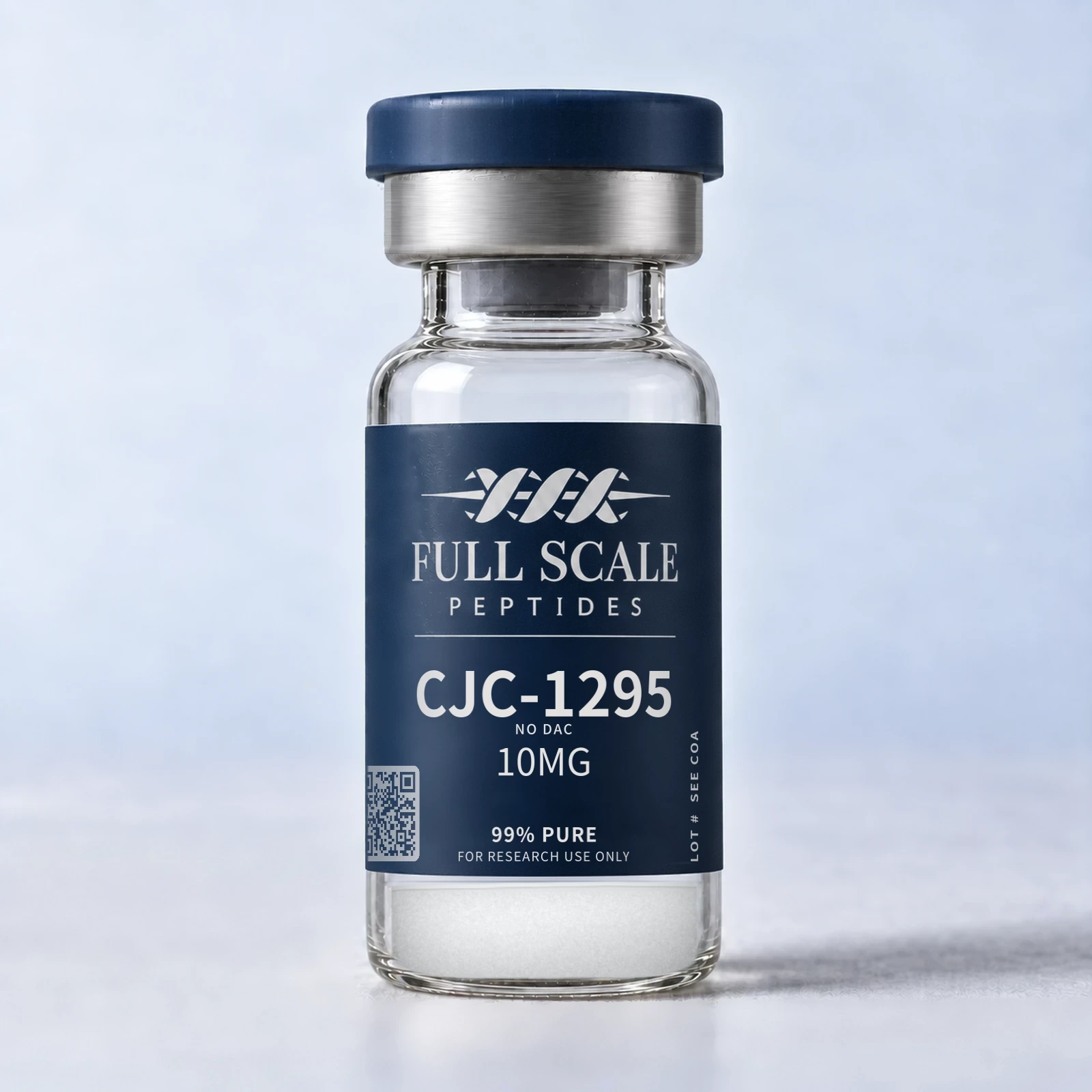
CJC-1295 No DAC 10mg, research grade
Freeze-dried powder with a third-party COA published before you buy, and tracked U.S. shipping. For laboratory research use only.
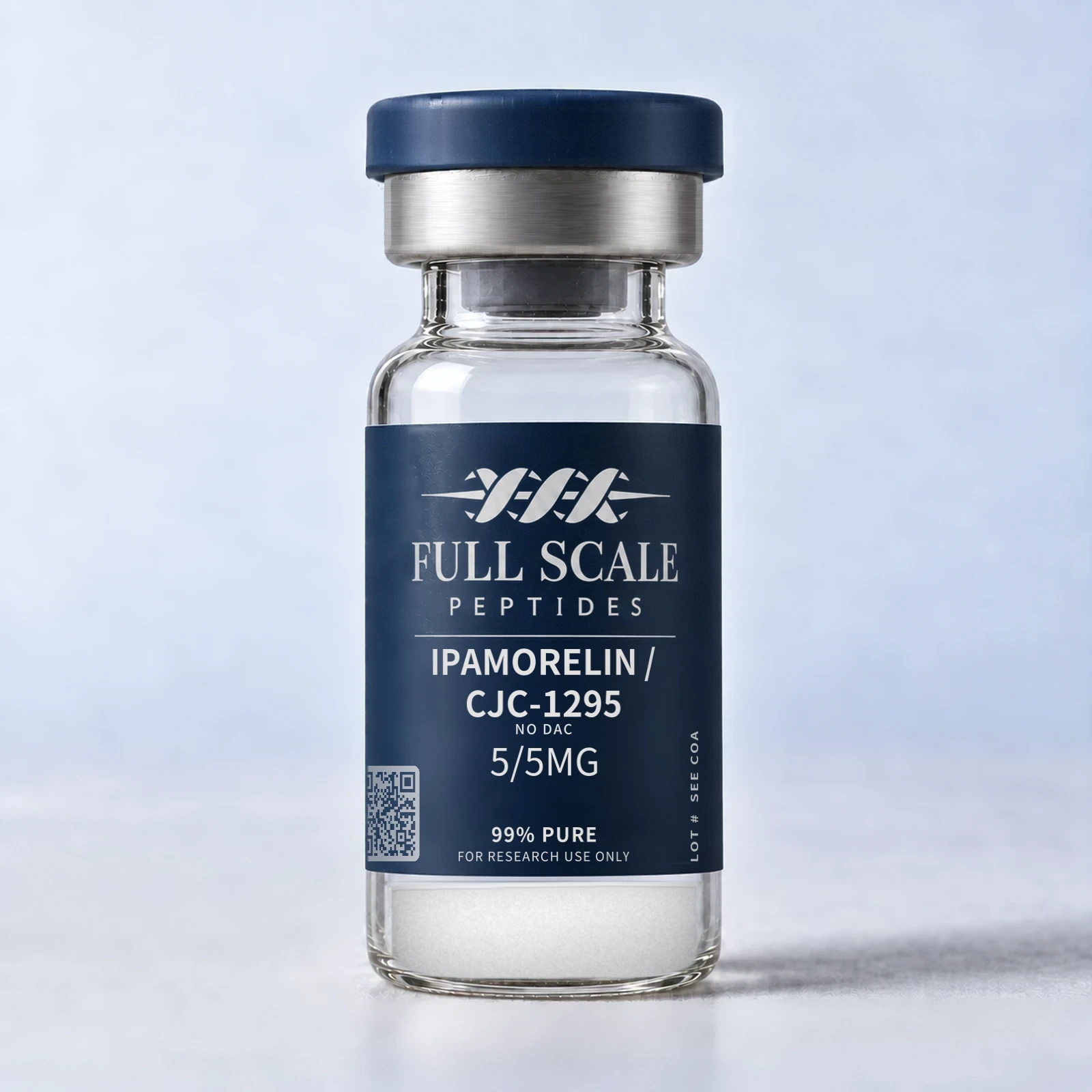
Ipamorelin / CJC-1295 No DAC 5/5mg, research grade
Both peptides in one vial, 5 mg each, with a third-party COA published before you buy. For laboratory research use only.
Purity and testing: why the COA matters
The four substitutions that define CJC-1295 (No DAC) are exactly what identity testing has to confirm. Every lot from Full Scale Peptides is tested by an independent lab, Freedom Diagnostics, before it is sold. HPLC measures purity, LC-MS confirms each sequence, and the full reports are published before you buy.
CJC-1295 No DAC 10mg
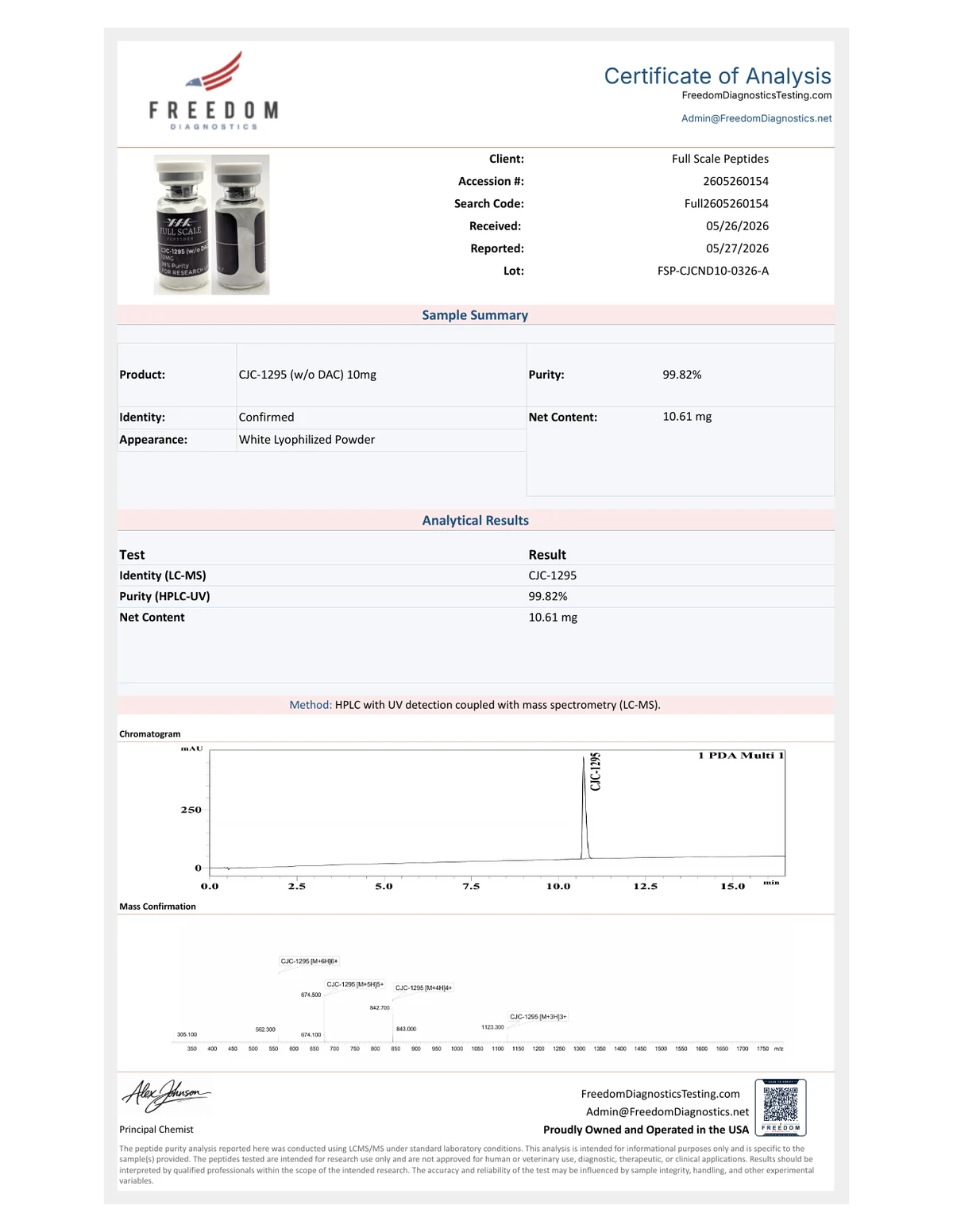
- Lot
- FSP-CJCND10-0326-A
- Tested
- May 27, 2026
- Lab
- Freedom Diagnostics
- Measured content
- 10.61 mg (10 mg labeled)
- Accession #
- 2605260154
- Report
- View full COA
New to reading lab reports? See how to read and verify a Certificate of Analysis and why 99%+ purity matters in research.
Ipamorelin / CJC-1295 No DAC 5/5mg blend
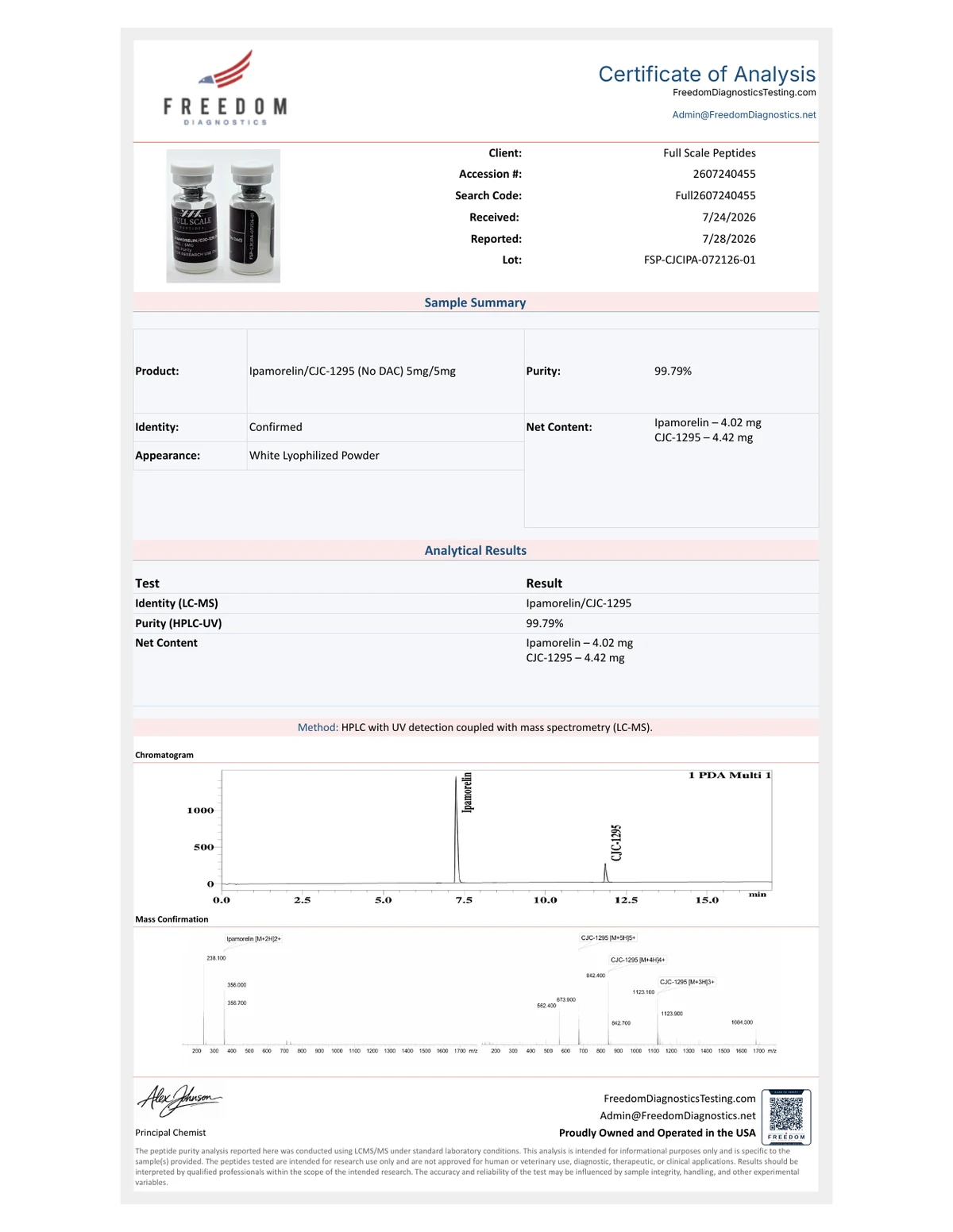
- Lot
- FSP-CJCIPA-072126-01
- Tested
- Jul 28, 2026
- HPLC purity
- 99.79%
- Measured content
- Ipamorelin 4.02 mg · CJC-1295 4.42 mg
- Accession #
- 2607240455
- Report
- View full COA
How these peptides are handled in the lab
Each peptide ships as a lyophilized (freeze-dried) powder, meaning the water has been removed to keep the peptide stable. Store sealed vials at −20 °C, protected from light. Before use in research it is reconstituted, or dissolved back into a liquid, usually with bacteriostatic water. Handling it the same careful way every time keeps results consistent:
- Let the sealed vial come to room temperature before opening it, to limit condensation.
- Add the water slowly down the inside wall of the vial, not directly onto the powder.
- Swirl gently until the powder is fully dissolved. Don’t shake it.
- Label the vial with the date, keep it refrigerated at 2–8 °C away from light, and avoid repeated freeze–thaw cycles.
For more detail, see our reconstitution guide and storage and handling best practices.
Key takeaways
- CJC-1295 (No DAC) is a stabilized GHRH analog, and Ipamorelin is a selective ghrelin-receptor agonist.
- The No DAC version produces a short GH pulse; the DAC version it is often confused with lasts about a week.
- Ipamorelin releases GH without meaningful ACTH or cortisol increases in the foundational studies.
- Together they act on two different receptors and can produce synergistic, pulsatile GH release in research models.
- Our current lots test at 99.82% (CJC-1295 No DAC) and 99.79% (blend), with full COAs published. For laboratory research use only.
Frequently asked questions
What is the difference between CJC-1295 with DAC and without DAC?
The DAC version binds albumin in the blood and lasts about a week. The No DAC version, also called modified GRF(1-29), lacks that anchor, clears quickly and produces a short GH pulse.
What makes Ipamorelin “selective”?
In the foundational studies it released growth hormone without meaningful increases in the stress hormones ACTH and cortisol, unlike older GH-releasing peptides.
Why combine CJC-1295 and Ipamorelin?
They act on two different receptors on the same pituitary cells, and research on this type of pairing has reported synergistic growth-hormone release.
What purity are Full Scale Peptides' CJC-1295 and Ipamorelin?
CJC-1295 No DAC 10mg (lot FSP-CJCND10-0326-A) measured 99.82%, and the Ipamorelin/CJC-1295 blend (lot FSP-CJCIPA-072126-01) measured 99.79% by HPLC, with identity confirmed by LC-MS. Full reports are in our COA library.
How are they supplied and stored?
Both ship as lyophilized powders in sealed glass vials. Store unopened vials at −20 °C away from light. Once reconstituted, keep refrigerated at 2–8 °C.
Are these peptides for human or veterinary use?
No. They are sold strictly for laboratory research. They are not for human or veterinary use and must not be administered to people or animals.
Scientific references
The findings summarized on this page come from published scientific literature, available on PubMed. Full Scale Peptides did not conduct, fund or sponsor this research, and nothing here implies endorsement by the authors or their institutions. The studies describe research on CJC-1295, Ipamorelin and the GH axis itself, not the product we supply.
- Kojima M, Hosoda H, Date Y, et al. Ghrelin is a growth-hormone-releasing acylated peptide from stomach. Nature. 1999;402(6762):656–660. PMID: 10604470
- Teichman SL, Neale A, Lawrence B, et al. Prolonged stimulation of growth hormone (GH) and insulin-like growth factor I secretion by CJC-1295, a long-acting analog of GH-releasing hormone, in healthy adults. J Clin Endocrinol Metab. 2006;91(3):799–805. PMID: 16352683
- Ionescu M, Frohman LA. Pulsatile secretion of growth hormone (GH) persists during continuous stimulation by CJC-1295, a long-acting GH-releasing hormone analog. J Clin Endocrinol Metab. 2006;91(12):4792–4797. PMID: 17018654
- Raun K, Hansen BS, Johansen NL, et al. Ipamorelin, the first selective growth hormone secretagogue. Eur J Endocrinol. 1998;139(5):552–561. PMID: 9849822
- Veldhuis JD, Bowers CY. Determinants of GH-releasing hormone and GH-releasing peptide synergy in men. Am J Physiol Endocrinol Metab. 2009;296(5):E1085–E1092. PMID: 19240251
Continue your research
For laboratory research use only. Not for human or veterinary use. The information on this page is provided for educational purposes and describes published research; it is not medical advice, and no statement here has been evaluated by the FDA.