
NAD+ (Nicotinamide Adenine Dinucleotide): A Plain-English Research Guide
On this page
What is NAD+?
NAD+ (nicotinamide adenine dinucleotide) is not a peptide. It's a coenzyme, a helper molecule found in every living cell and one of the most important molecules in biology. It carries electrons through the reactions that turn food into usable energy, and it's also the fuel several families of signaling enzymes run on.
Research interest has grown enormously over the past two decades because of one consistent finding: NAD+ levels fall with age in essentially every tissue studied, and that decline tracks with many features of cellular aging.12
NAD+ is an essential coenzyme that powers cellular energy production and fuels repair and signaling enzymes, and it is studied in laboratory research on metabolism and aging because its levels fall with age. Full Scale Peptides supplies it as a freeze-dried powder with a published COA, for research use only.
NAD+ at a glance
Living cell
NAD+ is found in all cells and is essential for turning nutrients into energy.
Jobs
It shuttles electrons in metabolism and is consumed as fuel by signaling enzymes.
Levels decline
Falling NAD+ with age is one of the best-replicated findings in aging biology.
Our current lot
HPLC purity for lot FSP-NAD500-0126-A, with identity confirmed by LC-MS.
NAD+ has two jobs
- Energy currency. In metabolism, NAD+ switches back and forth between its oxidized form (NAD+) and reduced form (NADH), carrying electrons into the mitochondria to produce energy. In this role it isn't used up. It's recycled thousands of times, and the NAD+/NADH ratio is a key readout of a cell's metabolic state.
- Enzyme fuel. Several enzyme families break NAD+ apart to power their work: sirtuins (SIRT1 to SIRT7), PARPs (DNA-repair enzymes) and the CD38 enzyme. This consumption is what makes NAD+ levels change over time.4
Why NAD+ declines, and why it matters
1. Sirtuins need NAD+
Sirtuins regulate mitochondria, DNA repair, inflammation and metabolic adaptation. In 2000, researchers showed that the yeast longevity protein Sir2 depends on NAD+ to work, linking NAD+ directly to aging research.3 Because sirtuin activity is limited by how much NAD+ is available, falling NAD+ is thought to slow these maintenance programs in aging cells.
2. PARPs compete for the same fuel
PARPs use large amounts of NAD+ when they respond to DNA damage. Aging tissue accumulates damage, so PARPs may drain the NAD+ pool, leaving less for sirtuins. This proposed vicious cycle of more damage, more NAD+ used and less repair is one of the field's central ideas.
3. CD38 rises with age
A 2016 study reported that the NAD+-consuming enzyme CD38 increases with age in mouse tissues and is a major driver of NAD+ decline in those models.5 That shifted attention from NAD+ being made more slowly to NAD+ being used up faster.
4. Restoring NAD+ in the lab
A large body of animal research has tested raising NAD+ in older animals, either with precursors such as NMN and NR or with NAD+ itself, and reported effects on mitochondrial function, blood vessels and metabolism in rodents.67
This page summarizes published laboratory and animal research. It does not describe supplements or any use in people or animals. NAD+ from Full Scale Peptides is sold strictly for laboratory research.
The age-related decline in NAD+ is well established. What restoring it achieves, especially in humans, is still unsettled: human trials with precursors have reliably raised NAD+-related markers in blood, with mixed results on function. Cells also don't simply absorb NAD+ intact; much of it is broken down and rebuilt inside the cell, which matters for experiment design.
What scientists study NAD+ for
- Aging biology. How and why NAD+ falls in different tissues, and what that does to cell function.12
- Mitochondrial function. Energy production, mitochondrial quality control and the sirtuin pathway.4
- DNA repair. How PARP activity and NAD+ availability interact under genotoxic stress.
- Metabolism. NAD+ in models of metabolic disease and energy balance.6
- Precursor comparisons. How NAD+, NMN and NR differ in uptake and effect.7
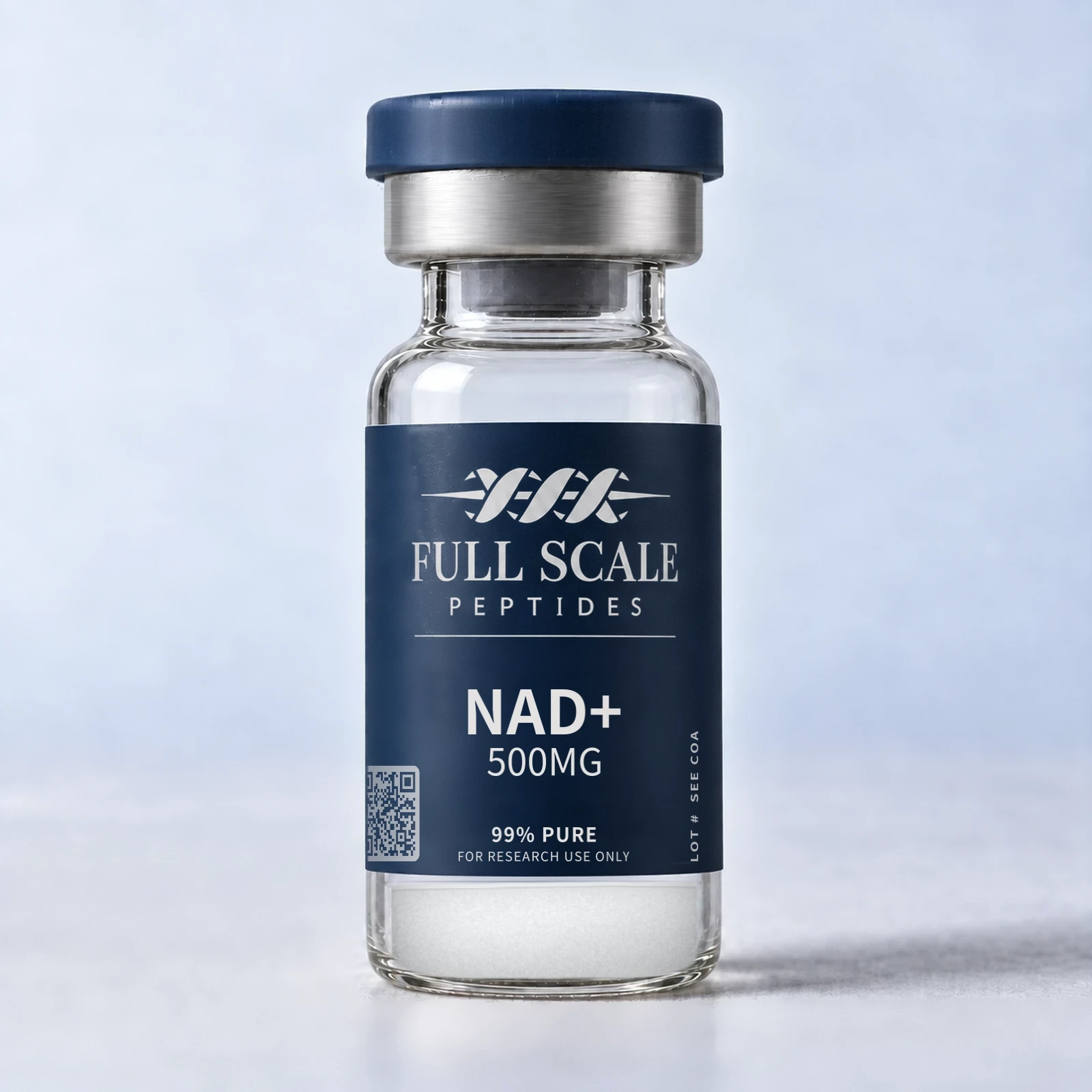
NAD+ 500mg, research grade
Freeze-dried powder with a third-party COA published before you buy, and tracked U.S. shipping. For laboratory research use only.
Purity and testing: why the COA matters
NAD+ is sensitive to heat, moisture and pH, and it breaks down into nicotinamide and related products that can quietly skew results. Every NAD+ lot from Full Scale Peptides is tested by an independent lab, Freedom Diagnostics, before it is sold. HPLC measures purity, LC-MS confirms identity, and the full report is published before you buy.
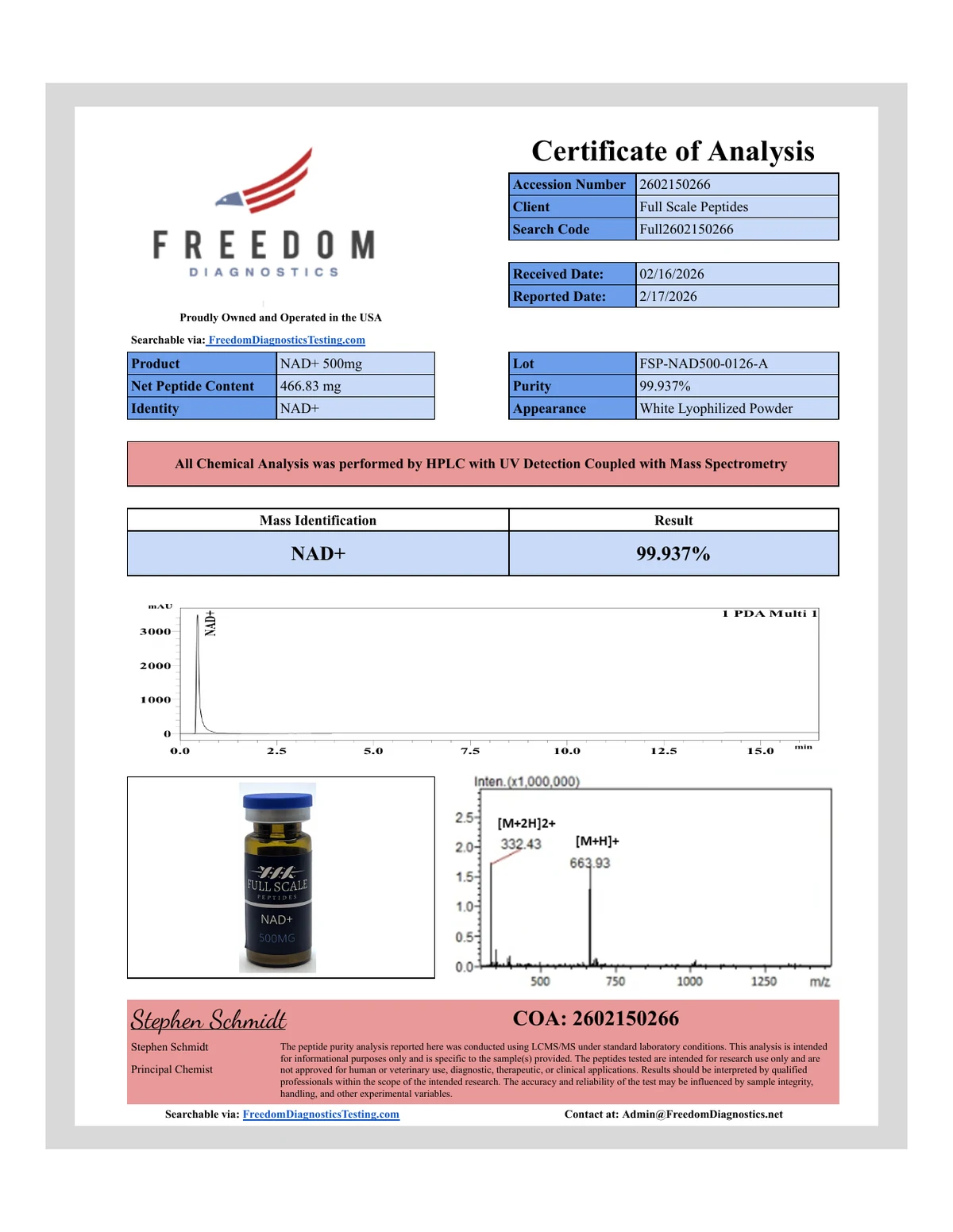
- Lot
- FSP-NAD500-0126-A
- Tested
- Feb 17, 2026
- Lab
- Freedom Diagnostics
- Measured content
- 466.83 mg (500 mg labeled)
- Accession #
- 2602150266
- Report
- View full COA
New to reading lab reports? See how to read and verify a Certificate of Analysis and why 99%+ purity matters in research.
How NAD+ is handled in the lab
NAD+ ships as a lyophilized (freeze-dried) powder, meaning the water has been removed to keep the peptide stable. Store sealed vials at −20 °C, protected from light and moisture. Before use in research it is reconstituted, or dissolved back into a liquid, usually with bacteriostatic water. Handling it the same careful way every time keeps results consistent:
- Let the sealed vial come to room temperature before opening it, to limit condensation.
- Add the water slowly down the inside wall of the vial, not directly onto the powder.
- Swirl gently until the powder is fully dissolved. Don’t shake it.
- Label the vial with the date, keep it refrigerated at 2–8 °C away from light, and avoid repeated freeze–thaw cycles.
For more detail, see our reconstitution guide and storage and handling best practices.
Because NAD+ is less stable in solution than many peptides, many protocols prepare it fresh or in small portions shortly before use.
Key takeaways
- NAD+ is an essential coenzyme, not a peptide, found in every living cell.
- It has two jobs: carrying electrons for energy production and fueling sirtuins, PARPs and CD38.
- NAD+ declines with age, and rising CD38 activity and PARP demand are leading explanations.
- Restoring NAD+ shows effects in animal models, but human results are still mixed.
- Our current lot tests at 99.94% purity, with identity confirmed by LC-MS and the full COA published. For laboratory research use only.
Frequently asked questions
Is NAD+ a peptide?
No. NAD+ is a coenzyme, a small molecule made from two nucleotides. It is often sold alongside peptides because it is studied in the same metabolism and aging research.
Why does NAD+ decline with age?
Research points to increased consumption, especially by the CD38 enzyme and by PARP enzymes responding to DNA damage, rather than only reduced production.
What is the difference between NAD+, NMN and NR?
NMN and NR are precursors that cells convert into NAD+. Researchers compare them because they differ in how they are taken up and processed.
What purity is Full Scale Peptides' NAD+?
The current lot (FSP-NAD500-0126-A) measured 99.94% purity by HPLC, with identity confirmed by LC-MS at Freedom Diagnostics. The full Certificate of Analysis is published in our COA library.
How is NAD+ supplied and stored?
It ships as a 500 mg lyophilized powder in a sealed glass vial. Store unopened vials at −20 °C away from light and moisture. Once reconstituted, keep it refrigerated at 2–8 °C and use it promptly.
Is NAD+ for human or veterinary use?
No. The NAD+ we supply is sold strictly for laboratory research. It is not for human or veterinary use and must not be administered to people or animals.
Scientific references
The findings summarized on this page come from published scientific literature, available on PubMed. Full Scale Peptides did not conduct, fund or sponsor this research, and nothing here implies endorsement by the authors or their institutions. The studies describe research on NAD+ itself, not the product we supply.
- Verdin E. NAD+ in aging, metabolism, and neurodegeneration. Science. 2015;350(6265):1208–1213. PMID: 26785480
- Massudi H, Grant R, Braidy N, et al. Age-associated changes in oxidative stress and NAD+ metabolism in human tissue. PLoS One. 2012;7(7):e42357. PMID: 22848760
- Imai S, Armstrong CM, Kaeberlein M, Guarente L. Transcriptional silencing and longevity protein Sir2 is an NAD-dependent histone deacetylase. Nature. 2000;403(6771):795–800. PMID: 10693811
- Covarrubias AJ, Perrone R, Grozio A, Verdin E. NAD+ metabolism and its roles in cellular processes during ageing. Nat Rev Mol Cell Biol. 2021;22(2):119–141. PMID: 33353981
- Camacho-Pereira J, Tarragó MG, Chini CCS, et al. CD38 dictates age-related NAD decline and mitochondrial dysfunction through an SIRT3-dependent mechanism. Cell Metab. 2016;23(6):1127–1139. PMID: 27304511
- Rajman L, Chwalek K, Sinclair DA. Therapeutic potential of NAD-boosting molecules: the in vivo evidence. Cell Metab. 2018;27(3):529–547. PMID: 29514064
- Yoshino J, Baur JA, Imai SI. NAD+ intermediates: the biology and therapeutic potential of NMN and NR. Cell Metab. 2018;27(3):513–528. PMID: 29249689
Continue your research
For laboratory research use only. Not for human or veterinary use. The information on this page is provided for educational purposes and describes published research; it is not medical advice, and no statement here has been evaluated by the FDA.