
MOTS-c: A Plain-English Research Guide
On this page
What is MOTS-c?
MOTS-c is a 16-amino-acid peptide with an unusual origin: it is encoded in the mitochondria's own DNA, not in the cell nucleus where almost all other genes live. Its name stands for Mitochondrial Open reading frame of the Twelve S rRNA type-c, because its code sits inside the mitochondrial gene for 12S ribosomal RNA.1
MOTS-c was discovered in 2015 by Pinchas Cohen's group at the University of Southern California.1 It belongs to a small, newly recognized class called mitochondrial-derived peptides. These are signals that mitochondria use to talk to the rest of the cell and, it now appears, to the rest of the body.4
MOTS-c is a 16-amino-acid peptide encoded by mitochondrial DNA that researchers study in metabolism, muscle function and aging because it appears to help cells adapt to metabolic stress. Full Scale Peptides supplies it as a freeze-dried powder with a published COA, for research use only.
MOTS-c at a glance
Amino acids
A short peptide coded inside the mitochondrial 12S rRNA gene.
Discovered
First described in Cell Metabolism by researchers at the University of Southern California.
Encoded by
One of very few peptides made from the mitochondria's own genetic code.
Our current lot
HPLC purity for lot FSP-MOTSC10-0326-A, with identity confirmed by LC-MS.
How MOTS-c works
1. Metabolism and insulin sensitivity
In the original 2015 study, MOTS-c acted mainly on skeletal muscle. It affected the folate cycle and a related metabolic pathway, which led to activation of AMPK, the cell's main energy sensor. In mice, it improved insulin sensitivity and prevented weight gain and insulin resistance on a high-fat diet.1
2. A signal that travels to the nucleus
A 2018 follow-up found that under metabolic stress, MOTS-c moves from the cell body into the nucleus, where it helps switch on protective genes, including antioxidant-response genes.2 That was striking evidence that mitochondria can directly influence the cell's main genome.
3. Exercise and muscle
MOTS-c levels rose with exercise in both muscle and blood in human research. In older mice, MOTS-c treatment improved physical capacity and markers of muscle health.3 A 2024 study reported that it binds and activates an enzyme called CK2 in muscle, a new clue to how it works.5
4. Natural genetic variation
A common variation in the MOTS-c sequence, called K14Q, occurs in some East Asian populations. It has been linked to differences in muscle-fiber composition and performance, which suggests the peptide's sequence matters in people as well as in lab models.6
This page summarizes published cell, animal and human-physiology research. It does not describe any use of MOTS-c in people or animals. MOTS-c from Full Scale Peptides is sold strictly for laboratory research.
What scientists study MOTS-c for
- Metabolic regulation. Insulin sensitivity, glucose handling and diet-induced obesity models.1
- Mitochondria-to-nucleus signaling. How mitochondria communicate with the rest of the cell under stress.2
- Exercise biology. MOTS-c as an exercise-induced signal and its effects on muscle.35
- Aging. Age-related physical decline and muscle maintenance in older animals.3
- Mitochondrial-derived peptides as a class. Comparing MOTS-c with related peptides such as humanin.4
MOTS-c was only discovered in 2015, so the field is young. Most mechanistic data come from mice and cell studies, and several key findings come from one research network. Treat it as a fast-moving research area rather than a settled one.
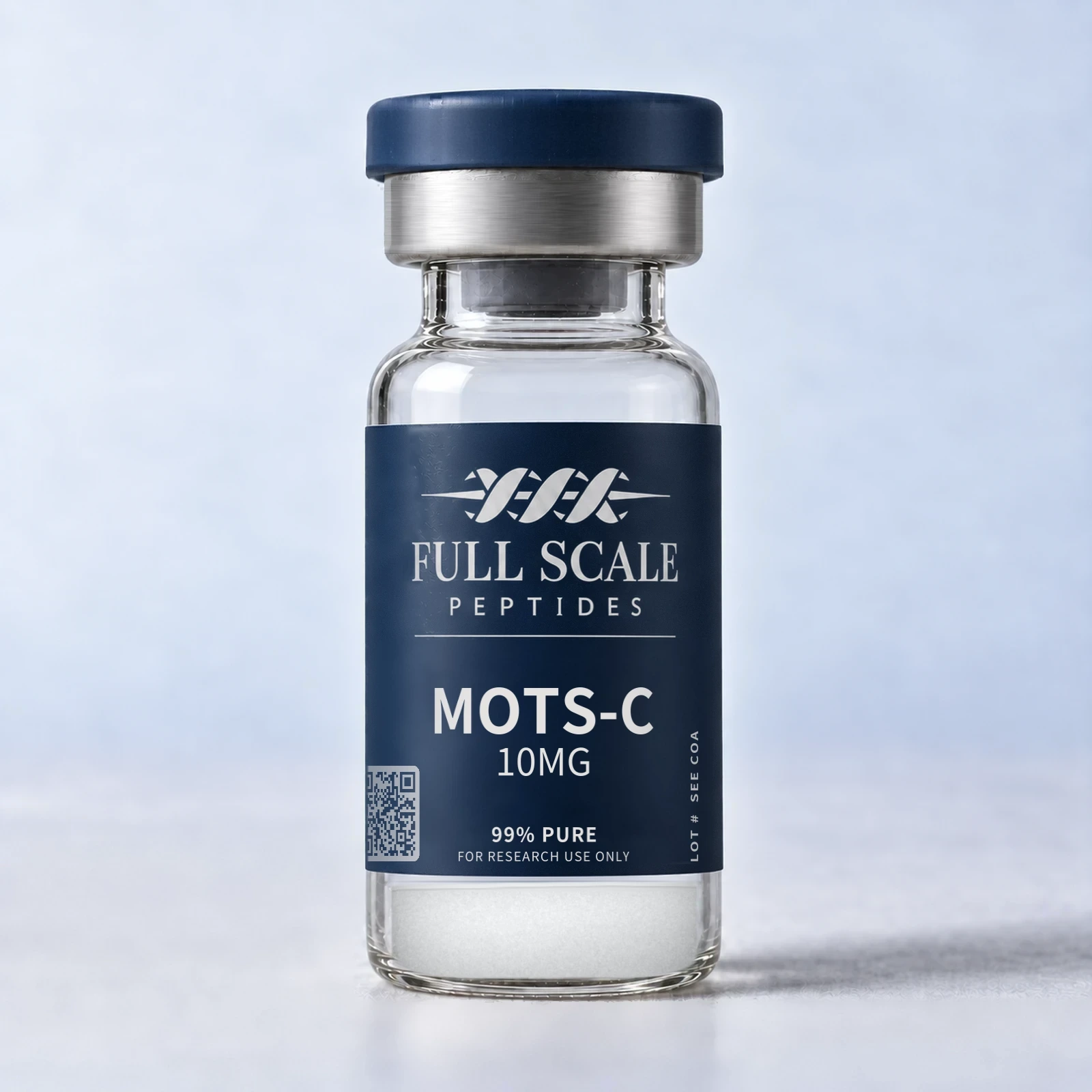
MOTS-c 10mg, research grade
Freeze-dried powder with a third-party COA published before you buy, and tracked U.S. shipping. For laboratory research use only.
Purity and testing: why the COA matters
MOTS-c is a newer research peptide, and quality across the market varies. Every MOTS-c lot from Full Scale Peptides is tested by an independent lab, Freedom Diagnostics, before it is sold. HPLC measures purity, LC-MS confirms the 16-amino-acid sequence, and the full report is published before you buy.
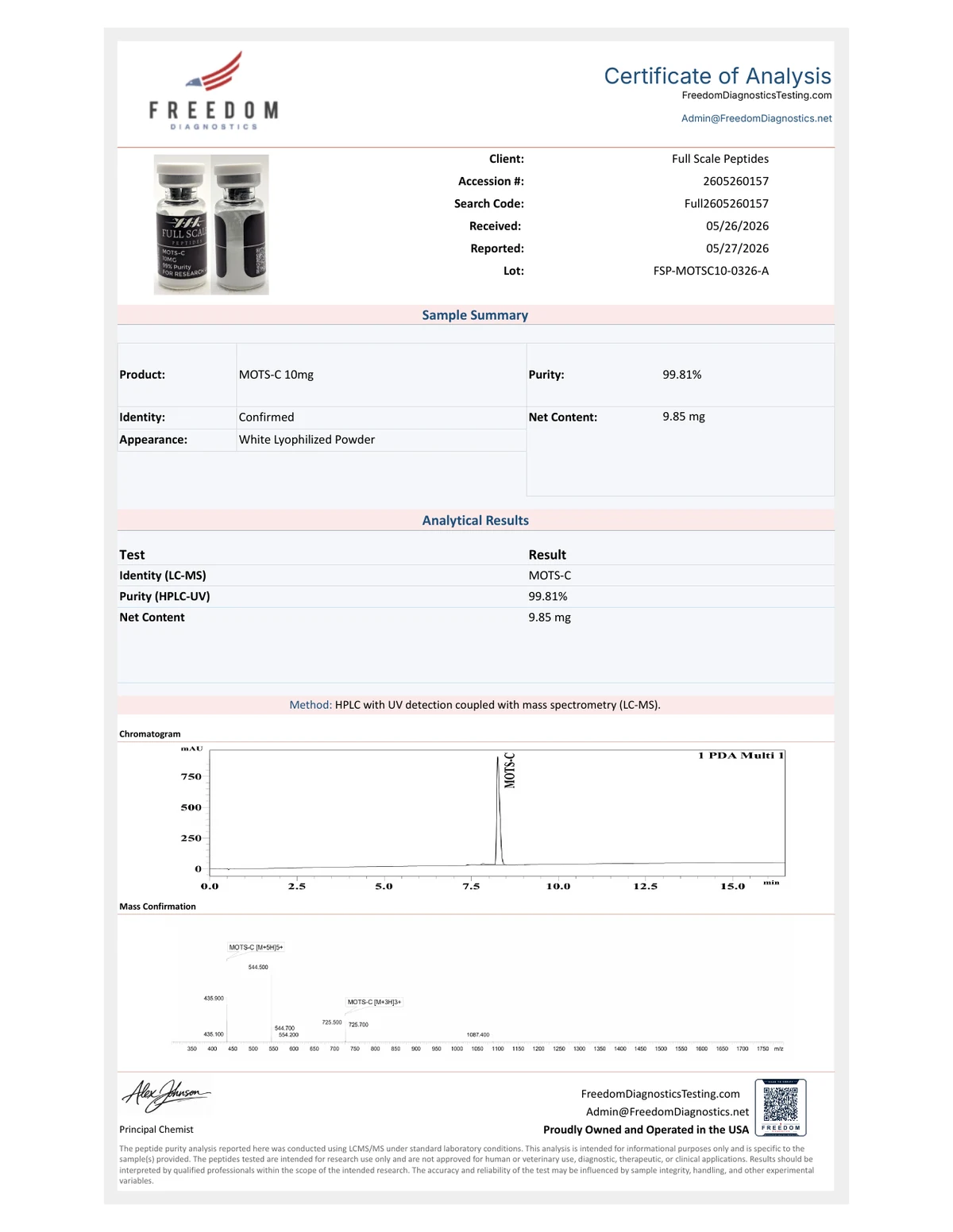
- Lot
- FSP-MOTSC10-0326-A
- Tested
- May 27, 2026
- Lab
- Freedom Diagnostics
- Measured content
- 9.85 mg (10 mg labeled)
- Accession #
- 2605260157
- Report
- View full COA
New to reading lab reports? See how to read and verify a Certificate of Analysis and why 99%+ purity matters in research.
How MOTS-c is handled in the lab
MOTS-c ships as a lyophilized (freeze-dried) powder, meaning the water has been removed to keep the peptide stable. Store sealed vials at −20 °C, protected from light. Before use in research it is reconstituted, or dissolved back into a liquid, usually with bacteriostatic water. Handling it the same careful way every time keeps results consistent:
- Let the sealed vial come to room temperature before opening it, to limit condensation.
- Add the water slowly down the inside wall of the vial, not directly onto the powder.
- Swirl gently until the powder is fully dissolved. Don’t shake it.
- Label the vial with the date, keep it refrigerated at 2–8 °C away from light, and avoid repeated freeze–thaw cycles.
For more detail, see our reconstitution guide and storage and handling best practices.
Key takeaways
- MOTS-c is a 16-amino-acid peptide encoded by mitochondrial DNA, discovered in 2015.
- It acts mainly on skeletal muscle, activates the energy sensor AMPK and improved insulin sensitivity in mice.
- Under stress it moves into the nucleus to help switch on protective genes.
- It rises with exercise and improved physical capacity in older mice, but the field is still young.
- Our current lot tests at 99.81% purity, with identity confirmed by LC-MS and the full COA published. For laboratory research use only.
Frequently asked questions
What does MOTS-c stand for?
Mitochondrial Open reading frame of the Twelve S rRNA type-c. The name describes where its genetic code sits inside mitochondrial DNA.
Why is MOTS-c unusual?
Almost all proteins and peptides are coded in the cell nucleus. MOTS-c is one of very few coded by the mitochondria's own DNA.
What is MOTS-c studied for?
Mainly metabolism and insulin sensitivity, exercise and muscle biology, and aging, in cell and animal research.
What purity is Full Scale Peptides' MOTS-c?
The current lot (FSP-MOTSC10-0326-A) measured 99.81% purity by HPLC, with identity confirmed by LC-MS at Freedom Diagnostics. The full Certificate of Analysis is published in our COA library.
How is MOTS-c supplied and stored?
It ships as a 10 mg lyophilized powder in a sealed glass vial. Store unopened vials at −20 °C away from light. Once reconstituted, keep the vial refrigerated at 2–8 °C.
Is MOTS-c for human or veterinary use?
No. It is sold strictly for laboratory research. It is not for human or veterinary use and must not be administered to people or animals.
Scientific references
The findings summarized on this page come from published scientific literature, available on PubMed. Full Scale Peptides did not conduct, fund or sponsor this research, and nothing here implies endorsement by the authors or their institutions. The studies describe research on MOTS-c itself, not the product we supply.
- Lee C, Zeng J, Drew BG, et al. The mitochondrial-derived peptide MOTS-c promotes metabolic homeostasis and reduces obesity and insulin resistance. Cell Metab. 2015;21(3):443–454. PMID: 25738459
- Kim KH, Son JM, Benayoun BA, et al. The mitochondrial-encoded peptide MOTS-c translocates to the nucleus to regulate nuclear gene expression in response to metabolic stress. Cell Metab. 2018;28(3):516–524.e7. PMID: 29983246
- Reynolds JC, Lai RW, Woodhead JST, et al. MOTS-c is an exercise-induced mitochondrial-encoded regulator of age-dependent physical decline and muscle homeostasis. Nat Commun. 2021;12(1):470. PMID: 33473109
- Merry TL, Chan A, Woodhead JST, et al. Mitochondrial-derived peptides in energy metabolism. Am J Physiol Endocrinol Metab. 2020;319(4):E659–E666. PMID: 32776825
- Kumagai H, Kim SJ, Miller B, et al. MOTS-c modulates skeletal muscle function by directly binding and activating CK2. iScience. 2024;27(11):111212. PMID: 39559755
- Kumagai H, Natsume T, Kim SJ, et al. The MOTS-c K14Q polymorphism in the mtDNA is associated with muscle fiber composition and muscular performance. Biochim Biophys Acta Gen Subj. 2022;1866(2):130048. PMID: 34728329
Continue your research
For laboratory research use only. Not for human or veterinary use. The information on this page is provided for educational purposes and describes published research; it is not medical advice, and no statement here has been evaluated by the FDA.