
Melanotan II: A Plain-English Research Guide
On this page
What is Melanotan II?
Melanotan II (MT-II) is a synthetic, cyclic peptide built to mimic alpha-melanocyte-stimulating hormone (α-MSH), the natural hormone that signals skin cells to make melanin pigment. It was designed in the late 1980s by a University of Arizona team led by Victor Hruby and Mac Hadley, who were looking for a stronger, longer-lasting version of α-MSH.12
Natural α-MSH is broken down within minutes. The Arizona team shortened it to its active core and closed it into a ring (a lactam bridge between two amino acids), giving the seven-residue structure Ac-Nle-cyclo[Asp-His-D-Phe-Arg-Trp-Lys]-NH₂.1 The ring makes the peptide far more resistant to breakdown and much more potent than the original hormone.
Melanotan II is a cyclic, long-acting copy of α-MSH that activates several melanocortin receptors, and it is used in laboratory research on pigmentation, appetite and energy balance, and melanocortin signaling. Full Scale Peptides supplies it as a freeze-dried powder with a published COA, for research use only.
Melanotan II at a glance
Amino acids in a ring
A cyclic version of the active core of α-MSH, designed for stability and potency.
First described
Cyclic lactam analogs of α-MSH were published by the Arizona group in the Journal of Medicinal Chemistry.
Receptors activated
MC1R, MC3R, MC4R and MC5R. It does not act on MC2R, the receptor for ACTH.
Our current lot
HPLC purity for lot FSP-MT2-072126-01, with identity confirmed by LC-MS.
The melanocortin system, explained simply
The body has five melanocortin receptors (MC1R to MC5R), and each one handles a different job. Melanotan II activates four of them, which is why it shows effects in so many different research areas:
- MC1R sits on pigment cells (melanocytes). Activating it switches melanin production toward darker eumelanin.
- MC3R and MC4R are found mainly in the brain, where they help regulate appetite, energy balance and sexual function.
- MC5R is found in exocrine glands and is linked to secretions such as sebum.
- MC2R is the receptor for ACTH, the stress hormone that drives cortisol. Melanotan II doesn't act on it.
Because it isn't selective, Melanotan II is a useful tool for studying the melanocortin system as a whole. Its lack of selectivity is also why it produces effects well beyond pigmentation.
What the research shows
- Pigmentation. A small pilot phase I study in the 1990s reported darkening of the skin on the face and upper body. It also recorded side effects including nausea, flushing and spontaneous erections.3
- Sexual function. The erections seen in early studies led to controlled work on erectile function, which reported that Melanotan II could start erections in men with erectile dysfunction.4
- Appetite and energy balance. In mice, Melanotan II reduced food intake, and blocking the same receptors increased feeding. That was early evidence that brain melanocortin receptors, especially MC4R, control appetite.5
This work led to two related compounds that were later approved as medicines, both of which are different molecules from Melanotan II. Afamelanotide (formerly Melanotan I) is a linear α-MSH analog, and bremelanotide (PT-141) is a close chemical relative of Melanotan II.2 Melanotan II itself has never been approved as a medicine anywhere.
Melanotan II has not been approved for any use in people, and health regulators in several countries have warned against unlicensed “tanning” products that contain it. This page summarizes published research only. Melanotan II from Full Scale Peptides is sold strictly for laboratory research and must not be used on people or animals.
Safety signals in the literature
Because Melanotan II acts on several receptor systems at once, the research record includes a wide range of reported side effects, from nausea and flushing to changes in blood pressure. There are also published case reports of changes in moles and of melanoma in people who used unlicensed Melanotan II products.6 Case reports can't prove cause and effect, but they're a big reason researchers treat the compound as a laboratory tool rather than something with a proven safety record.
Most of the human data on Melanotan II are small and early-stage, and nearly all come from the 1990s and early 2000s. It is best understood as a research tool for probing the melanocortin system, not as a well-characterized compound.
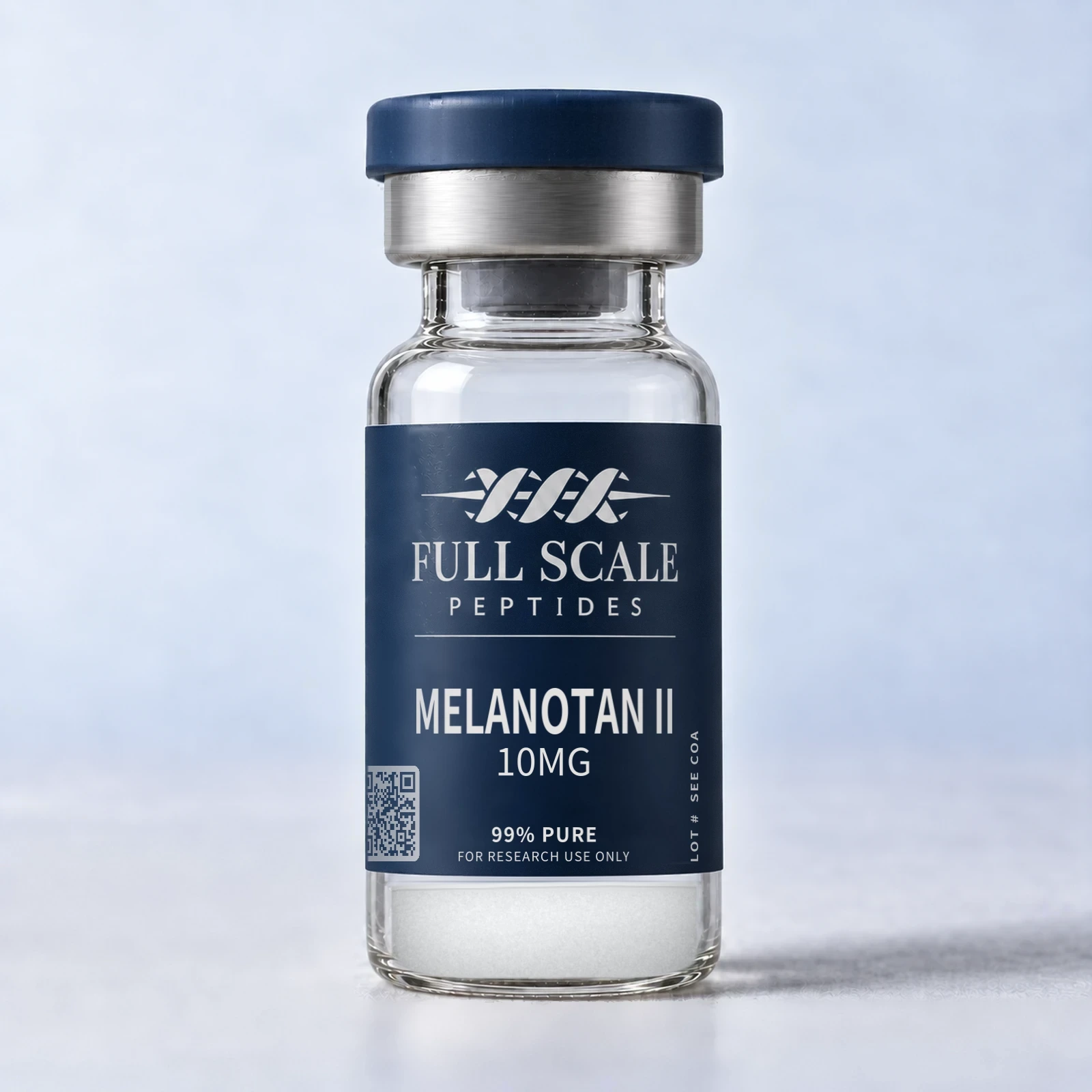
Melanotan II 10mg, research grade
Freeze-dried powder with a third-party COA published before you buy, and tracked U.S. shipping. For laboratory research use only.
Purity and testing: why the COA matters
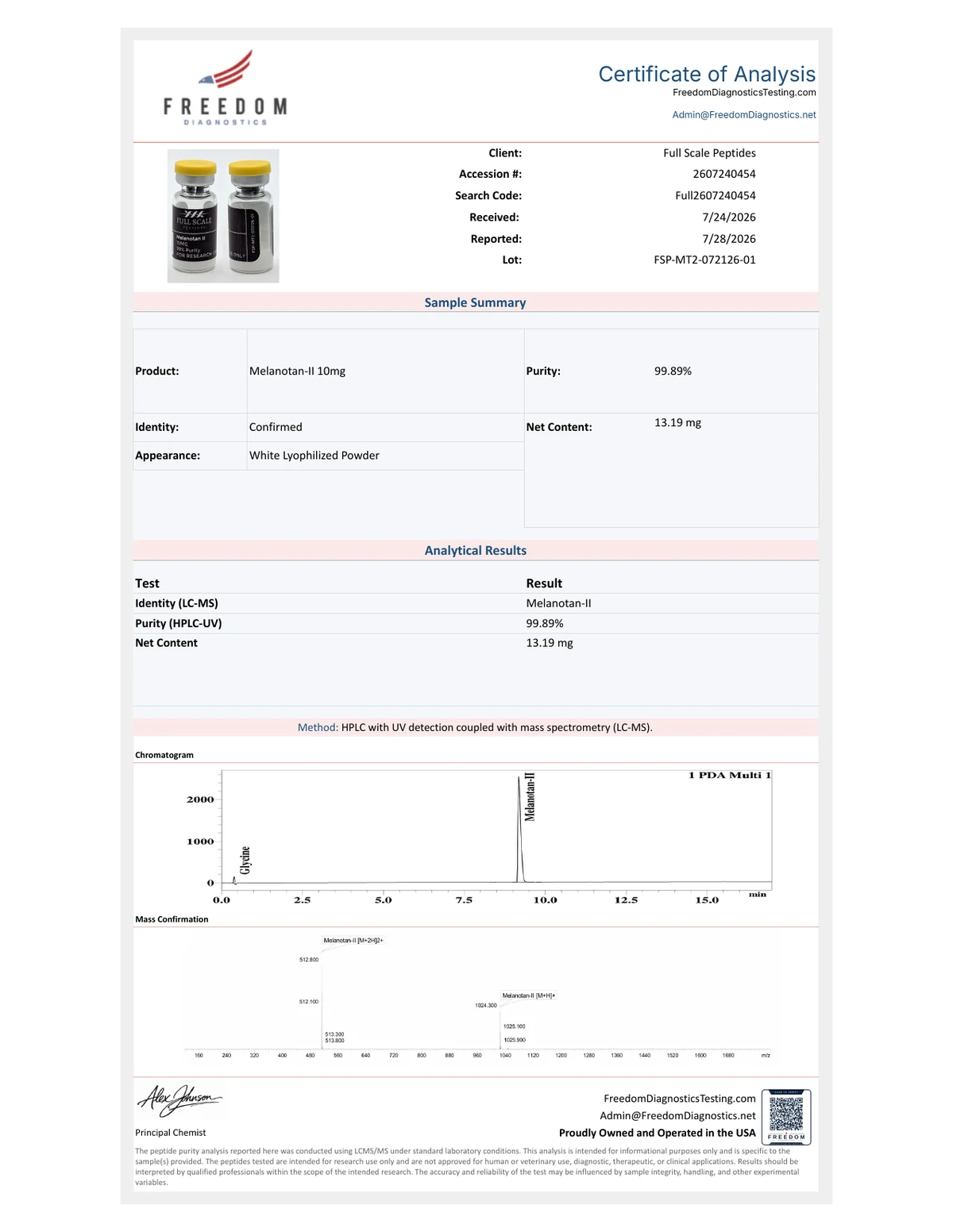
Melanotan II is one of the most widely sold unregulated peptides, so product quality varies a lot. For research, only verified material makes sense. Every lot from Full Scale Peptides is tested by an independent lab, Freedom Diagnostics, before it is sold. HPLC measures purity, LC-MS confirms the cyclic structure is the correct molecule, and the full report is published before you buy.
- Lot
- FSP-MT2-072126-01
- Tested
- Jul 28, 2026
- Lab
- Freedom Diagnostics
- Measured content
- 13.19 mg (10 mg labeled)
- Accession #
- 2607240454
- Report
- View full COA
New to reading lab reports? See how to read and verify a Certificate of Analysis and why 99%+ purity matters in research.
How Melanotan II is handled in the lab
Melanotan II ships as a lyophilized (freeze-dried) powder, meaning the water has been removed to keep the peptide stable. Store sealed vials at −20 °C, protected from light. Before use in research it is reconstituted, or dissolved back into a liquid, usually with bacteriostatic water. Handling it the same careful way every time keeps results consistent:
- Let the sealed vial come to room temperature before opening it, to limit condensation.
- Add the water slowly down the inside wall of the vial, not directly onto the powder.
- Swirl gently until the powder is fully dissolved. Don’t shake it.
- Label the vial with the date, keep it refrigerated at 2–8 °C away from light, and avoid repeated freeze–thaw cycles.
For more detail, see our reconstitution guide and storage and handling best practices.
Key takeaways
- Melanotan II is a cyclic, long-acting copy of α-MSH, designed at the University of Arizona in the late 1980s.
- It activates four of the five melanocortin receptors (MC1R, MC3R, MC4R and MC5R), which explains its wide range of effects.
- It was studied for pigmentation, sexual function and appetite, and that work led to related medicines that are different molecules.
- It has never been approved for human use, and the literature includes safety signals and case reports.
- Our current lot tests at 99.89% purity, with identity confirmed by LC-MS and the full COA published. For laboratory research use only.
Frequently asked questions
What is the difference between Melanotan I and Melanotan II?
Melanotan I (afamelanotide) is a linear analog of α-MSH that was later approved as a medicine for a rare light-sensitivity condition. Melanotan II is a cyclic analog that is more potent, less selective and has never been approved.
Is Melanotan II the same as PT-141?
No, but they are closely related. PT-141 (bremelanotide) is a chemical relative of Melanotan II that was developed separately and approved for a specific medical use.
Which receptors does Melanotan II act on?
It activates MC1R, MC3R, MC4R and MC5R. It does not act on MC2R, the ACTH receptor.
What purity is Full Scale Peptides' Melanotan II?
The current lot (FSP-MT2-072126-01) measured 99.89% purity by HPLC, with identity confirmed by LC-MS at Freedom Diagnostics. The full Certificate of Analysis is published in our COA library.
How is Melanotan II supplied and stored?
It ships as a 10 mg lyophilized powder in a sealed glass vial. Store unopened vials at −20 °C away from light. Once reconstituted, keep the vial refrigerated at 2–8 °C.
Is Melanotan II for human or veterinary use?
No. It is sold strictly for laboratory research. It is not for human or veterinary use, is not a tanning product and must not be administered to people or animals.
Scientific references
The findings summarized on this page come from published scientific literature, available on PubMed. Full Scale Peptides did not conduct, fund or sponsor this research, and nothing here implies endorsement by the authors or their institutions. The studies describe research on Melanotan II and related melanocortin peptides itself, not the product we supply.
- Al-Obeidi F, Castrucci AM, Hadley ME, et al. Potent and prolonged acting cyclic lactam analogues of alpha-melanotropin: design based on molecular dynamics. J Med Chem. 1989;32(12):2555–2561. PMID: 2555512
- Hadley ME, Dorr RT. Melanocortin peptide therapeutics: historical milestones, clinical studies and commercialization. Peptides. 2006;27(4):921–930. PMID: 16412534
- Dorr RT, Lines R, Levine N, et al. Evaluation of melanotan-II, a superpotent cyclic melanotropic peptide in a pilot phase-I clinical study. Life Sci. 1996;58(20):1777–1784. PMID: 8637402
- Wessells H, Gralnek D, Dorr R, et al. Effect of an alpha-melanocyte stimulating hormone analog on penile erection and sexual desire in men with organic erectile dysfunction. Urology. 2000;56(4):641–646. PMID: 11018622
- Fan W, Boston BA, Kesterson RA, et al. Role of melanocortinergic neurons in feeding and the agouti obesity syndrome. Nature. 1997;385(6612):165–168. PMID: 8990120
- Yassin Alsabbagh A, Bhujel N, Singh RP, et al. Melanotan II nasal spray: a possible risk factor for oral mucosal malignant melanoma? Int J Oral Maxillofac Surg. 2025;54(9):806–808. PMID: 40210573
Continue your research
For laboratory research use only. Not for human or veterinary use. The information on this page is provided for educational purposes and describes published research; it is not medical advice, and no statement here has been evaluated by the FDA.