What is retatrutide?
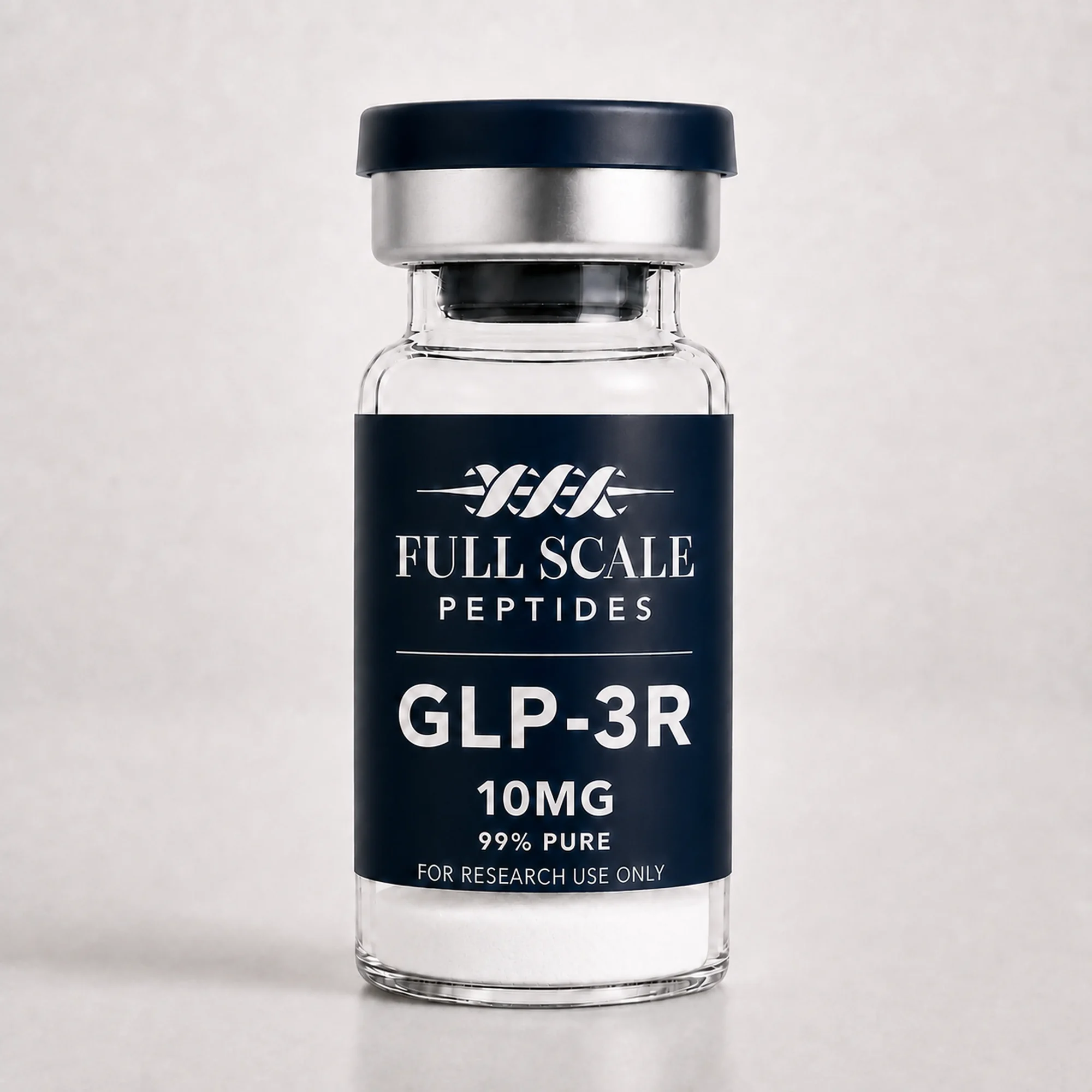
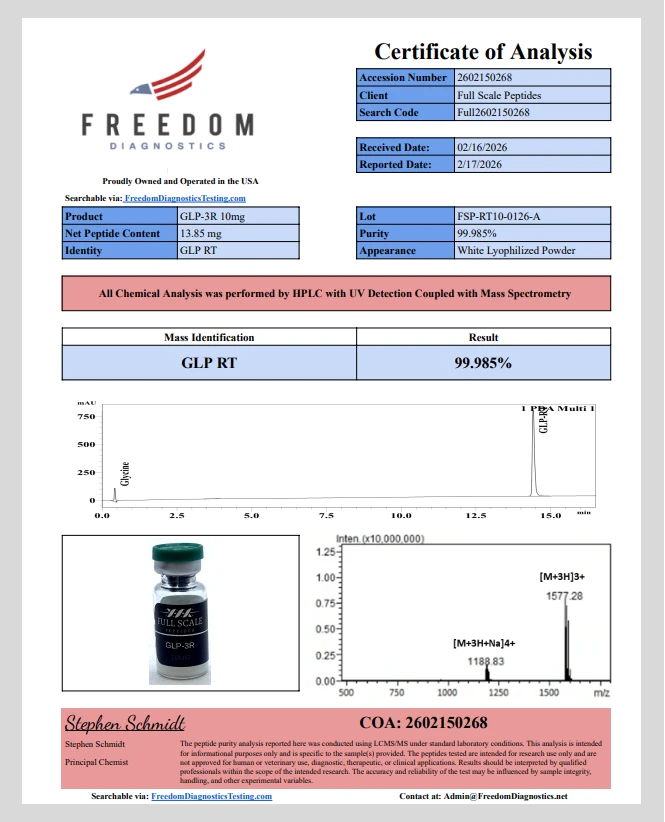
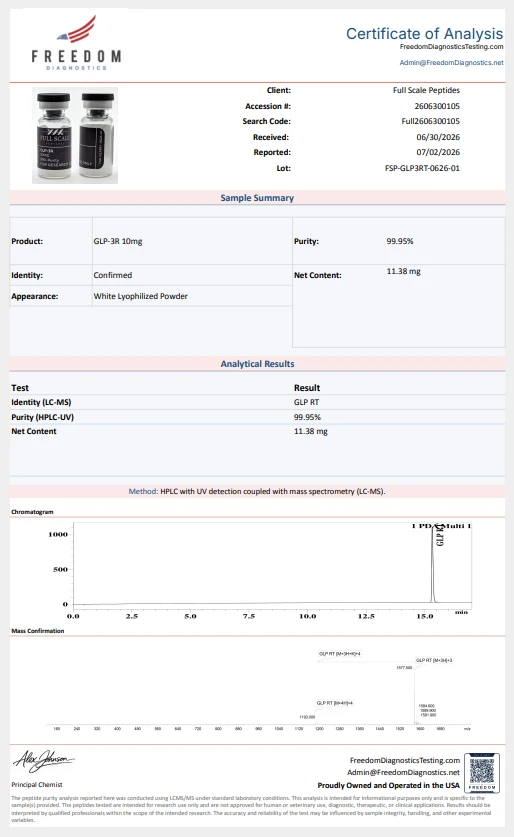
Retatrutide (also designated LY3437943, and listed here as GLP-3R) is a synthetic peptide of 39 amino acids engineered as a triple receptor agonist, targeting the GLP-1, GIP, and glucagon receptors simultaneously. Originally developed by Eli Lilly, it remains an investigational compound with no approved formulation. Full Scale Peptides supplies it as a lyophilized powder at ≥99% purity by HPLC for laboratory research, with a batch Certificate of Analysis published on this page.
How does the triple agonist mechanism work?
The tri-receptor design is what makes retatrutide a subject of laboratory interest. GLP-1 and GIP signaling are studied for their roles in insulin secretion and lipid handling, while glucagon receptor activation is examined in the context of hepatic fat oxidation and energy expenditure. Engaging all three pathways within a single molecule allows investigation of receptor cross-talk that selective agonists cannot isolate.
How does retatrutide compare to tirzepatide and semaglutide?
| Retatrutide (GLP-3R) | Tirzepatide | Semaglutide | |
|---|---|---|---|
| Receptor targets | GLP-1 + GIP + glucagon | GLP-1 + GIP | GLP-1 |
| Agonist class | Triple | Dual | Single |
| Amino acids | 39 | 39 | 31 |
| Research focus | Receptor cross-talk, hepatic lipid metabolism | Incretin pathway synergy | GLP-1 pathway selectivity |
| Regulatory status | Investigational | Approved formulations exist | Approved formulations exist |
Glucagon receptor engagement is the distinguishing variable — it’s the pathway the dual and single agonists don’t address, and the reason retatrutide is studied separately in energy expenditure models.
What is retatrutide used for in laboratory research?
- Insulin secretion pathways — downstream signaling cascades in cellular models
- Adipose tissue models — lipid storage and mobilization
- Hepatic lipid metabolism — fat oxidation in preclinical systems
- Energy homeostasis — whole-system energy balance in preclinical research
- Receptor cross-talk — comparative signaling against single- and dual-agonist controls
Specifications
| Compound | Retatrutide (GLP-3R, LY3437943) |
| CAS number | 2381089-83-2 |
| Molecular formula | C₂₂₁H₃₄₂N₄₆O₆₈ |
| Molecular weight | 4731.33 g/mol |
| Sequence length | 39 amino acids |
| Net peptide content | 10 mg |
| Purity | ≥99% (HPLC) |
| Identity confirmation | Mass spectrometry |
| Form | Lyophilized powder, sealed vial |
| Storage | −20°C, protect from light and moisture |
| Reconstitution | Bacteriostatic water or sterile laboratory solvent |
| Testing laboratory | Freedom Diagnostics (independent third party) |
How is retatrutide stored and reconstituted?
Store the sealed lyophilized vial at −20°C, protected from light and moisture. Reconstitute with bacteriostatic water or a sterile laboratory solvent, directing the stream against the vial wall rather than onto the powder. Store reconstituted material refrigerated and protected from light, and avoid repeated freeze-thaw cycles, which degrade peptide structure. See storage and handling best practices.
Certificate of Analysis
Every batch is third-party tested by Freedom Diagnostics for identity, purity, and net peptide content. The COA for this batch is published on this page — before you buy, not sent on request. Learn how to read a COA, or browse the full COA library.
Research background
Further reading in our retatrutide triple agonist research overview.
Research use only. Not for human or veterinary consumption. Not evaluated or approved by the FDA for any use.