
GLP-3R Triple Agonist: A Plain-English Research Guide
On this page
What is GLP-3R?
GLP-3R is a triple receptor agonist: a single peptide designed to activate three hormone receptors involved in appetite, blood sugar and energy use. Those are the receptors for GLP-1 (glucagon-like peptide-1), GIP (glucose-dependent insulinotropic polypeptide) and glucagon. The first discovery and clinical data for this triple-agonist design were published in 2022.1
Earlier metabolic peptides worked on one receptor (GLP-1 agonists) or two (GLP-1 plus GIP “twincretins”). Adding the glucagon receptor is the key idea. GLP-1 and GIP mostly act on how much energy comes in, while glucagon signaling is studied for its effects on how much energy is burned and on fat handling in the liver. That combination is why triple agonists have become one of the most closely watched areas of metabolic research.
GLP-3R is a single peptide that activates the GLP-1, GIP and glucagon receptors at the same time, studied in laboratory and clinical research on body weight, blood sugar and liver fat. Full Scale Peptides supplies it as a freeze-dried powder with a published COA, for research use only.
GLP-3R at a glance
Receptors activated
GLP-1, GIP and glucagon, all from one molecule rather than a combination of drugs.
First described
Discovery and first clinical data for the triple-agonist design were published in Cell Metabolism.
Phase 2 weight change
Mean body-weight reduction at the highest dose after 48 weeks in the phase 2 obesity trial.
Our current lot
HPLC purity for lot FSP-GLP3RT-0626-01, with identity confirmed by LC-MS.
The three receptor systems
Each receptor contributes something different, which is why researchers study them together:
- GLP-1 receptor. Associated with glucose-dependent insulin release, slower stomach emptying and appetite signaling in the brain.
- GIP receptor. Enhances insulin release after meals and is studied for its role in fat-tissue metabolism. In the discovery work, the molecule was tuned to be most potent at the GIP receptor, with lower relative potency at the GLP-1 and glucagon receptors.1
- Glucagon receptor. Increases energy expenditure and mobilizes fat, especially in the liver. On its own, glucagon raises blood sugar, so pairing it with GLP-1 and GIP activity is what makes the combination workable in research designs.
The molecule also carries a fatty-acid side chain that binds to albumin in the blood, which slows its clearance. In the early human studies, this gave it a half-life of about six days, long enough to support once-weekly dosing schedules in clinical protocols.1
What the research shows
The triple-agonist design moved from discovery to phase 2 trials quickly, and those trials are what put triple agonism on the map:
- Obesity (phase 2, 48 weeks). In a trial of 338 adults with obesity, the highest dose produced a mean body-weight reduction of 24.2% at 48 weeks, compared with about 2% with placebo.2
- Type 2 diabetes (phase 2, 36 weeks). Participants saw reductions in HbA1c of up to about 2 percentage points, along with dose-dependent weight loss, compared with placebo and an active GLP-1 comparator.3
- Liver fat (MASLD substudy). In participants with metabolic dysfunction–associated steatotic liver disease, higher doses produced relative reductions in liver fat of more than 80%, and most participants on those doses reached normal liver-fat levels.4
The liver findings connect directly to the glucagon arm of the molecule. Triple agonists are studied in models of hepatic steatosis because glucagon receptor activity in the liver drives fat mobilization, which is a mechanism single and dual agonists don’t directly target. Larger phase 3 programs have since followed.
The clinical results above come from pharmaceutical trials run under medical supervision. They describe the compound studied in those trials, not the research-grade material we supply, and nothing on this page describes or supports use in people or animals.
Why a third receptor matters
Dual GLP-1/GIP agonists mainly reduce energy intake. Researchers expected that adding glucagon receptor activity would also raise energy expenditure, so the body both takes in less and burns more. The phase 2 data were consistent with that idea: the weight reductions reported for the highest dose were larger than those typically reported for single-receptor GLP-1 agonists over a similar time frame.2
The trade-offs are also part of the research picture. Across the trials, the most common adverse events were gastrointestinal and dose-related, and heart-rate increases were tracked closely. That’s one reason dose-escalation design is a major topic in this literature.23
Triple agonism is a young field. Most published data come from phase 2 trials of one to two years or less, and long-term findings are still emerging. Treat any single result as one data point, not a settled conclusion.
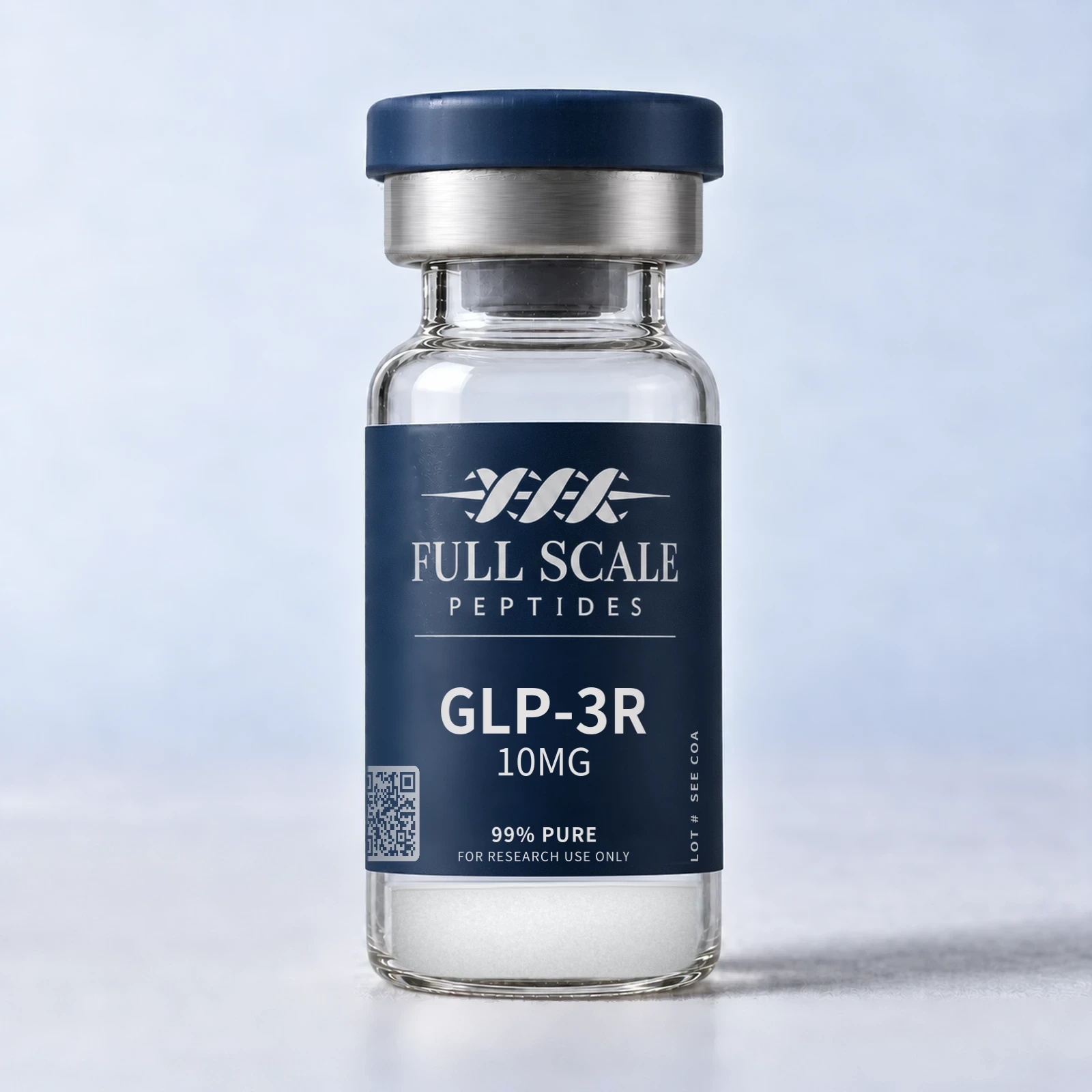
GLP-3R 10mg, research grade
Freeze-dried powder with a third-party COA published before you buy, and tracked U.S. shipping. For laboratory research use only.
Purity and testing: why the COA matters
For a peptide this size, sequence errors or truncated fragments are a real risk, and they can quietly ruin an experiment. Every GLP-3R lot from Full Scale Peptides is tested by an independent lab, Freedom Diagnostics, before it is sold. HPLC measures purity, LC-MS confirms the molecular identity, and the full report is published on the site before you buy.
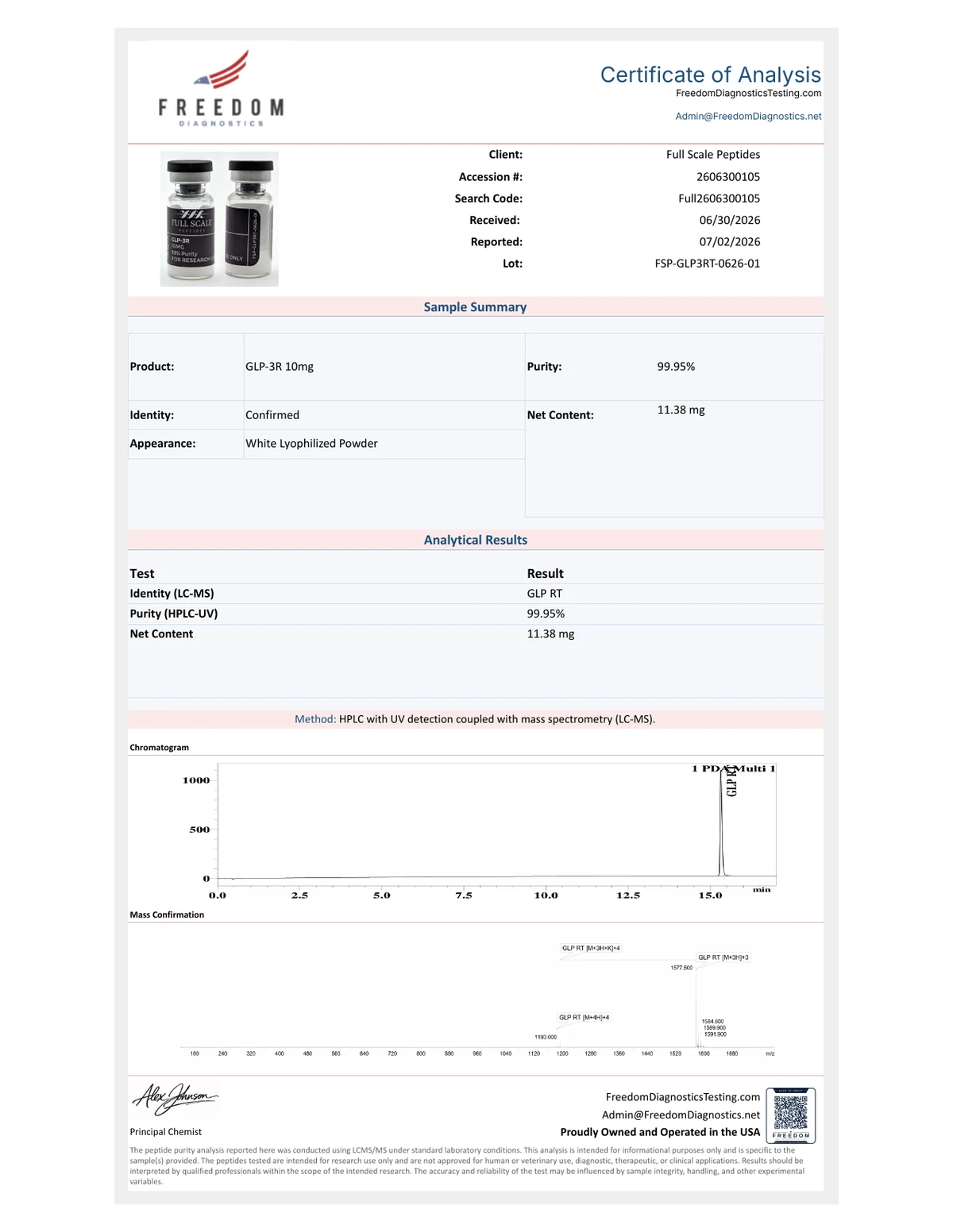
- Lot
- FSP-GLP3RT-0626-01
- Tested
- Jul 2, 2026
- Lab
- Freedom Diagnostics
- Measured content
- 11.38 mg (10 mg labeled)
- Accession #
- 2606300105
- Report
- View full COA
New to reading lab reports? See how to read and verify a Certificate of Analysis and why 99%+ purity matters in research.
How GLP-3R is handled in the lab
GLP-3R ships as a lyophilized (freeze-dried) powder, meaning the water has been removed to keep the peptide stable. Store sealed vials at −20 °C, protected from light. Before use in research it is reconstituted, or dissolved back into a liquid, usually with bacteriostatic water. Handling it the same careful way every time keeps results consistent:
- Let the sealed vial come to room temperature before opening it, to limit condensation.
- Add the water slowly down the inside wall of the vial, not directly onto the powder.
- Swirl gently until the powder is fully dissolved. Don’t shake it.
- Label the vial with the date, keep it refrigerated at 2–8 °C away from light, and avoid repeated freeze–thaw cycles.
For more detail, see our reconstitution guide and storage and handling best practices.
Key takeaways
- GLP-3R is a triple agonist that activates the GLP-1, GIP and glucagon receptors from a single molecule.
- The glucagon arm is what sets it apart, and it is linked to energy expenditure and liver-fat mobilization.
- Phase 2 trials reported a 24.2% mean weight reduction at the highest dose over 48 weeks, and large relative reductions in liver fat.
- Most data are recent and short to medium term, so the field is still developing.
- Our current lot tests at 99.95% purity, with identity confirmed by LC-MS and the full COA published. For laboratory research use only.
Frequently asked questions
What does GLP-3R stand for?
It refers to a triple receptor agonist: a single peptide that activates the GLP-1, GIP and glucagon receptors.
How is GLP-3R different from a GLP-1 agonist?
A GLP-1 agonist activates one receptor. GLP-3R adds GIP and glucagon receptor activity, and the glucagon component is studied for its effects on energy expenditure and liver fat.
What did the phase 2 trials find?
In adults with obesity, the highest dose produced a mean body-weight reduction of 24.2% at 48 weeks. Separate phase 2 work reported improvements in blood sugar in type 2 diabetes and large reductions in liver fat.
What purity is Full Scale Peptides' GLP-3R?
The current lot (FSP-GLP3RT-0626-01) measured 99.95% purity by HPLC, with identity confirmed by LC-MS at Freedom Diagnostics. The full Certificate of Analysis is on the product page and in our COA library.
How is GLP-3R supplied and stored?
It ships as a 10 mg lyophilized powder in a sealed glass vial. Store unopened vials at −20 °C away from light. Once reconstituted, keep the vial refrigerated at 2–8 °C.
Is GLP-3R for human or veterinary use?
No. It is sold strictly for laboratory research. It is not for human or veterinary use and must not be administered to people or animals.
Scientific references
The findings summarized on this page come from published scientific literature, available on PubMed. Full Scale Peptides did not conduct, fund or sponsor this research, and nothing here implies endorsement by the authors or their institutions. The studies describe research on GLP-1/GIP/glucagon triple agonists itself, not the product we supply.
- Coskun T, Urva S, Roell WC, et al. Cell Metab. 2022;34(9):1234–1247.e9. PMID: 35985340
- Jastreboff AM, Kaplan LM, Frías JP, et al. N Engl J Med. 2023;389(6):514–526. PMID: 37366315
- Rosenstock J, Frias J, Jastreboff AM, et al. Lancet. 2023;402(10401):529–544. PMID: 37385280
- Sanyal AJ, Kaplan LM, Frias JP, et al. Nat Med. 2024;30(7):2037–2048. PMID: 38858523
Continue your research
For laboratory research use only. Not for human or veterinary use. The information on this page is provided for educational purposes and describes published research; it is not medical advice, and no statement here has been evaluated by the FDA.